
US Markets, for Non-US Investors
Best brokers, tax strategies & options income methods and case study built for non-US investors.
Compare Top Brokers • Options Income Strategies • Made for Non-US Investors
No sponsored rankings. No broker pays for rankings or placement.
50+
Guides Published
200+
Countries Covered
5,000+
Monthly Readers
$0
Paid Placements
From −70% Drawdown to +$492K
A full breakdown of a TQQQ position: where the thesis broke, what the recovery plan actually looked like, and the numbers at each step. Includes the mistakes.
Read the case study−70%
Starting Loss
+$492K
Final Gain
TQQQ
Strategy
IBKR
Broker Used
Where Do You Want To Start?
Pick the section that matches your situation. Each one is written with non-US residency in mind.
Best Brokers
Broker comparisons by country, with actual fees, market access, and account opening notes.
9 guidesStart Here
A plain walkthrough for investors new to US markets from outside the United States.
Begin with the basicsUS Investing
How non-US residents actually open accounts and buy US stocks, ETFs, and options.
9 guidesOptions Income
Covered calls and cash-secured puts with the assumptions, math, and risk clearly shown.
9 guidesTaxes
W-8BEN, dividend withholding, and treaty rates explained without the legal filler.
8 guidesStrategies
Leveraged ETFs, dividend funds, and TQQQ research with the tradeoffs laid out.
19 guidesCase Study
Write-ups of actual trades and outcomes, including the positions that did not work.
Real portfoliosBroker Finder
Find which brokers accept investors from your country, compared side by side.
Match your countryTax Map
Interactive world map of US tax treaty status, withholding rates, and W-8BEN requirements.
Treaty rates visualLatest Articles
New research and notes, written for investors outside the US.

US-Denmark Tax Treaty for Investors: The Complete 2026 Guide
US-Denmark tax treaty guide for individual investors. Withholding rates on dividends, the aktiesparekonto PFIC trap for US citizens, the 0% pension fund rate, W-8BEN filing, and how Danish aktieindkomst tax interacts with US rules.

US-Czech Republic Tax Treaty for Investors: The Complete 2026 Guide
US-Czech Republic tax treaty guide for individual investors. Withholding rates on dividends, the 3-year capital gains exemption, W-8BEN filing, and how Czech tax law interacts with US rules explained.

US-China Tax Treaty for Investors: The Complete 2026 Guide
US-China tax treaty guide for individual investors. Withholding rates on dividends, the broker access problem for mainland residents, the Hong Kong distinction, W-8BEN filing, and the FATCA gap explained.
What This Site Is
Built around a non-US investor perspective from the start. Not US content with a translation layer on top.
Independent
No broker pays for rankings. Ordering is based on actual fees, available markets, and account access.
Non-US Lens
Residency, tax treaty, and broker access are treated as primary constraints, not footnotes.
Specific Topics
W-8BEN, dividend withholding, leverage decay, and options income - each topic is handled in depth.
Real Numbers
Case studies come from live portfolios and public data, not idealized backtests or rounded summaries.
Frequently Asked Questions
Can I invest in US stocks if I live outside the US?
Yes. Non-US residents can legally hold US stocks and ETFs through brokers that accept international accounts, such as Interactive Brokers, eToro, and Saxo. You file a W-8BEN with the broker so any reduced treaty rate can be applied to dividends.
Which broker works best for non-US investors?
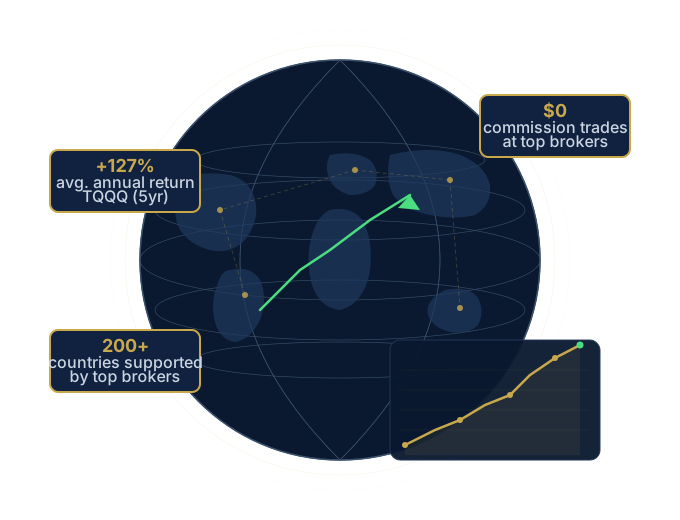
For most people, Interactive Brokers offers the strongest combination of low fees, broad market access (150+ markets, 200+ countries), and serious tools. eToro is simpler to start with. The right fit depends on your country of residence, the assets you need, and how active you plan to be.
How much US tax applies to dividends for non-residents?
The default US withholding on dividends paid to non-residents is 30%. A valid W-8BEN combined with a tax treaty can reduce that rate, often to 15%. Your country of residence may still tax the same dividend separately, so the effective rate depends on both jurisdictions.
Is TQQQ safe to hold long term?
TQQQ is a 3x leveraged ETF. It can compound strongly during sustained uptrends, but volatility decay and deep drawdowns in bear markets are real. It is not a passive buy-and-forget holding and needs active position sizing and risk management.
Is the site actually independent?
Yes. No broker pays for ranking or placement. Some links are affiliate links and may earn a commission if you sign up, but that does not change what gets ranked first or what the content says.