
Disclosure: This article may contain affiliate links. If you click and make a purchase or open an account, we may earn a commission at no extra cost to you. See our full disclosure policy.
From -70% to +470K: A Real TQQQ Recovery Case Study
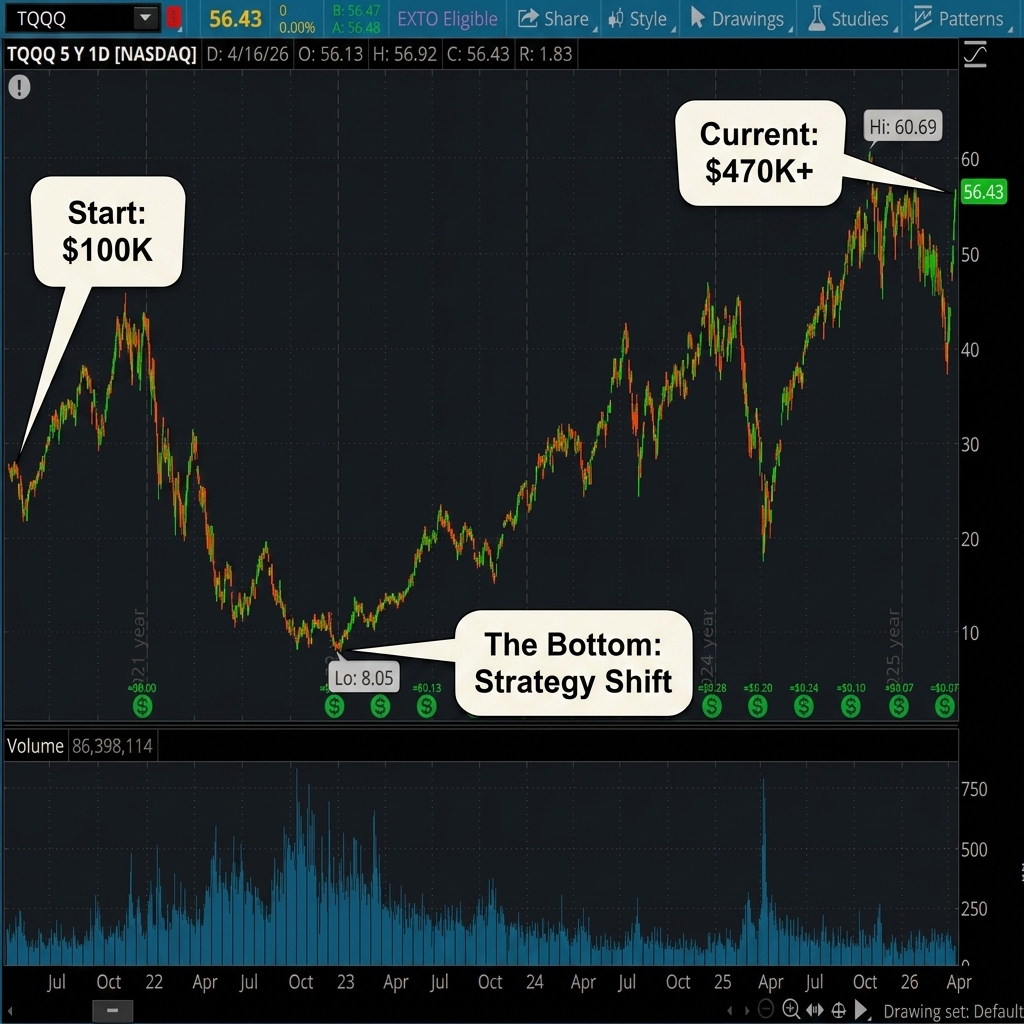
[!IMPORTANT] The Short Version
- Started: $100,000 (Jan 2022)
- Bottom: ~$28,000 (-70%)
- Strategy shift: Feb 2023
- Added: $40,000 as cash collateral
- Total investment: $140,000
- Current: $470,000+
- Method: TQQQ + Covered Calls + Short Puts
This is not a success story. It’s a reconstruction after a near wipeout.
1. What Actually Went Wrong
As an international investor entering the US market, my first mistake was relying on theory without understanding real market dynamics. I entered the US market with theoretical knowledge and zero real experience.
What I did:
- Traded options aggressively
- Increased position size during losses
- Treated options like stocks
- Stayed glued to the screen
What that caused:
- Time decay worked against me
- Leverage amplified mistakes
- Emotional decisions replaced logic
Result: ~$100K → ~$28K within a year. No edge. No system. Just exposure and hope.
2. The Turning Point (Late 2022)
At the bottom of the bear market, I stopped trading and started thinking.
[!NOTE] Key Observation
- The Nasdaq had recovered from every major crash historically.
- TQQQ had dropped ~83% from its peak.
Thesis: If the Nasdaq recovers, TQQQ amplifies it. If I am willing to hold long-term, volatility becomes noise. This was not a certainty; it was a probability bet.
3. The Actual Strategy (No Simplifications)
Core Position
- Bought ~2,000 shares of TQQQ at ~$25
- Added ~$40,000 as cash collateral
This cash addition was specifically to support selling puts without using broker margin, reducing leverage risk and keeping the exposure backed by real capital.
Layer 1: Covered Calls
What I did: Sold calls continuously against my shares.
Rules (practical, not theoretical):
- After strong rallies → sell higher strike
- In sideways markets → sell closer to At-The-Money (ATM)
- Rolled when needed (not automatically)
Reality: The calls capped my upside multiple times, and I missed gains during sharp upside moves. However, the strategy remained profitable overall due to steady premium flow.
Layer 2: Short Puts
What I did: Sold puts using my cash collateral.
Rules:
- After market drops → sell closer strikes
- In calm markets → go further Out-of-The-Money (OTM)
Reality: Some puts were assigned at bad timing, which increased my exposure during drawdowns. This required strong conviction to continue executing.
4. What Actually Drove Returns
An Additional Factor (important for non-US investors): Returns are measured in USD, but actual results depend on your local currency. In my case, USD depreciation against the ILS reduced real returns despite significant portfolio growth.
The recovery was not driven by one single thing, but a combination of factors:
- TQQQ recovery (the main driver)
- Continuous premium collection
- Time in the market (rather than timing trades daily)
Approximate contribution (not exact):
- 60–70%: Underlying asset recovery
- 30–40%: Options income
5. What Did NOT Go Smoothly
This part matters most. It was not a straight line up.
Drawdowns During Recovery The portfolio dropped from ~$465K to ~$340K at one point. I had no hedge in place, and exposure remained high.
Covered Call Pain During strong market rallies, shares were often called away. I was forced to either re-enter at higher prices or permanently lose the upside on those shares.
Put Risk Selling puts in falling markets increased risk. If the downtrend had continued, it could have compounded losses significantly.
Psychological Pressure (Still Present) While there was less outright panic than in 2022, it still required immense discipline to step back and not interfere with the strategy.
6. Failure Scenarios (Real Risk)
This strategy is not foolproof. It breaks under these specific conditions:
- Prolonged sideways market (2–5 years): Volatility decay erodes TQQQ. Options premium may not be enough to offset the underlying losses.
- Repeated downtrends: Put assignments stack up, and capital gets locked in losing positions.
- Early entry (wrong timing): Entering at higher price levels leads to deep drawdowns, and recovery may take years.
- Liquidity / margin pressure: Holding multiple positions reduces flexibility. If margin calls hit, you can’t adjust when needed.
7. What I Would Do Differently & Tools
Looking back, here is how I would adjust my approach:
- Never allocate 100% to a leveraged ETF. Cap exposure at 20–30%.
- Define exit rules before entry.
- Track performance monthly, not just total P&L, to separate emotion from data.
Recommended Broker (Affiliate Link Placeholder)
To effectively run multi-leg option strategies with low margin rates and proper cash collateral management, having the right broker is essential.
[Insert Interactive Brokers Affiliate Link Here]
8. What Actually Changed
What changed wasn’t the market itself. It was my behavior.
Before:
- Constant monitoring
- Emotional decisions
- Overtrading
After:
- Fewer decisions
- Defined structure
- Letting positions work
9. The Bottom Line
This worked because the entry was near a major macro low, the market recovered strongly, and the options strategy added income on top. This is not repeatable on demand. If the same conditions don’t exist, the results will change completely.
Final Note
This is a case study of recovery, not a blueprint. The biggest risk in leveraged ETFs is not volatility—it’s applying a volatile strategy in the wrong market environment.
Disclaimer: Not financial advice.
Written by GetGlobalYields Team
Leveraging over 20 years of expertise as a software developer, I apply a rigorous analytical and systems-driven mindset to the world of high-yield investing. I specialize in leveraged ETFs (TQQQ) and advanced options strategies, focusing on generating consistent returns through data-driven risk management and technical market analysis. As the founder of Get Global Yields, I am dedicated to helping expats and international investors navigate the US markets with precision, turning complex financial instruments into sustainable global wealth.