
[!NOTE] Key Stats:
- Asset: TQQQ (ProShares UltraPro QQQ)
- Duration: Jan 2022 - April 2026 (Ongoing)
- Strategy Type: Wheel Strategy / Leveraged Long-Term Holding
[!IMPORTANT] The Short Version
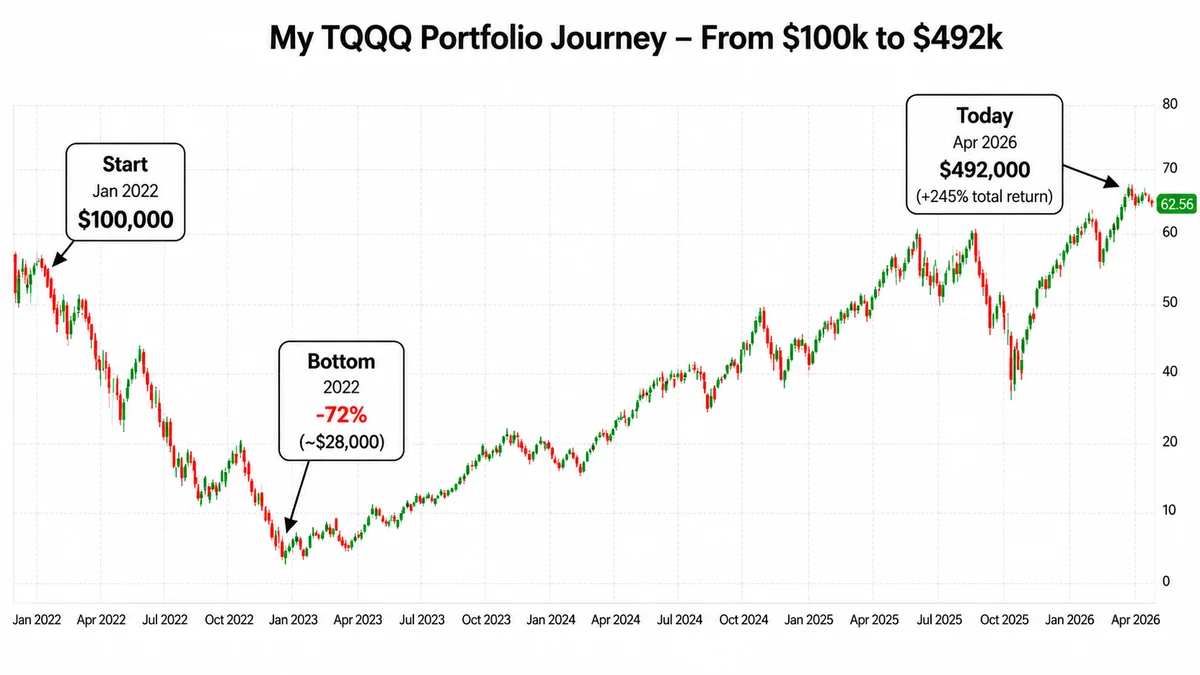
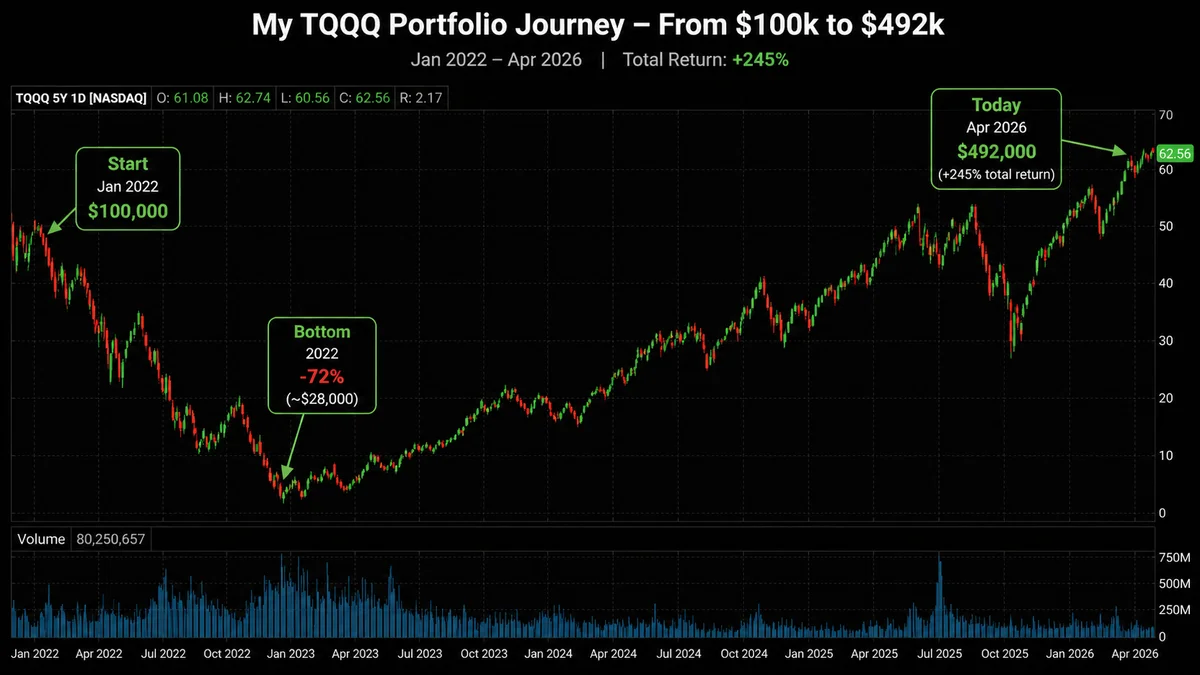
- Started: $100,000 (Jan 2022)
- Bottom: ~$28,000 (-72%)
- Added collateral: $40,000 (Feb 2023)
- Total invested: $140,000
- Current value: $492,000 (over +250%) - April 2026
- Method: TQQQ + Covered Calls + Short Puts
This is not a success story. It’s a reconstruction after a near wipeout.
1. What Actually Went Wrong
As an international investor entering the US market, my first mistake was relying on theory without understanding real market dynamics.
What I did:
- Traded options aggressively
- Increased size during losses
- Treated options like stocks
- Stayed glued to the screen
What that caused:
- Time decay worked against me
- Leverage amplified every mistake
- Emotional decisions replaced logic
Result: $100,000 → $28,000 within a year No edge. No system. Just exposure and hope.
2. The Turning Point (Late 2022)
At the bottom, I stopped trading and started thinking.
[!NOTE] Key observation: The Nasdaq had recovered from every major crash in history. TQQQ had dropped ~83% from its peak.
Thesis: If Nasdaq recovers → TQQQ amplifies it 3x If I’m willing to hold long-term → volatility becomes noise
This was not certainty. This was a probability bet.
3. The Actual Strategy
Core position:
- Bought ~2,000 shares of TQQQ at ~$25
- Added $40,000 as cash collateral to support selling puts without broker margin
Layer 1: Covered Calls
Sold calls continuously against shares.
Practical rules:
- After strong rallies → sell higher strike
- In sideways markets → sell closer to ATM
- Rolled when needed, not automatically
Reality:
- Calls capped upside multiple times
- Missed gains during sharp moves
- Still profitable overall due to premium flow
Layer 2: Short Puts
Sold puts using cash collateral.
Practical rules:
- After drops → sell closer strikes
- In calm markets → go further OTM
Reality:
- Some puts were assigned at bad timing
- Increased exposure during drawdowns
- Required strong conviction to continue
4. What Actually Drove Returns
Not one thing. A combination:
| Driver | Contribution |
|---|---|
| TQQQ underlying recovery | 60–70% |
| Options premium income | 30–40% |
[!WARNING] Important note for non-US investors: Returns are measured in USD. Actual results depend on your local currency. In my case, USD depreciation vs ILS reduced real returns despite portfolio growth.
The Leverage Factor: While a standard investment in QQQ would have recovered significantly during this period, it wouldn’t have provided the same fuel for the options engine. The 3x leverage of TQQQ is what allowed for such a dramatic recovery but it came with 3x the heartaches in 2022.
🔗 Read the full breakdown: TQQQ vs. QQQ: Which is Right for International Investors? - Explore the math behind the decay risk and why I chose the leveraged path.
5. What Did NOT Go Smoothly
Drawdowns during recovery:
- Portfolio dropped from ~$465,000 to ~$340,000
- No hedge in place
- Exposure remained high throughout
Covered call pain:
- Strong rallies → shares called away
- Forced to re-enter higher or lose upside
Put risk:
- Selling puts in falling markets increased exposure
- Could have compounded losses if trend continued
Psychological pressure:
- Less panic than 2022
- Still required discipline not to interfere
6. Failure Scenarios
This strategy breaks under these conditions:
| Scenario | Why it breaks |
|---|---|
| Prolonged sideways market (2–5 years) | Volatility decay erodes TQQQ; premium may not offset losses |
| Repeated downtrends | Put assignments stack; capital gets locked |
| Early entry at wrong timing | Entering at higher levels means deep drawdown and years to recover |
| Liquidity pressure | Multiple positions reduce flexibility; can’t adjust when needed |
7. What I Would Do Differently
- Never allocate 100% to a leveraged ETF
- Cap exposure at 20–30%
- Define exit rules before entry
- Track performance monthly, not just total
8. What Actually Changed
Not the market. My behavior.
| Before | After |
|---|---|
| Constant monitoring | Fewer decisions |
| Emotional decisions | Defined structure |
| Overtrading | Letting positions work |
Chapter 3: The System Running Now (April 2026)
Current portfolio value: $492,000 (net liquid - after buying back all options at today’s prices)
Active positions:
| Position | Details |
|---|---|
| TQQQ shares | 6,000 shares @ $58.59 |
| 60 Covered Calls | Strike $62.5 | January 2027 | Sold at $10.1 |
| 60 Short Puts | Strike $50 | January 2027 | Sold at $10.1 |
| Current options liability | ~$114,150 (This represents the cost to buy back the options today; it effectively becomes profit if they expire worthless). |
The Three Scenarios - January 2027
Scenario 1: TQQQ above $62.5 → Portfolio ~$620,000
- Shares called away at $62.5
- Options expire worthless → $114,150 liability disappears
- Gain from price move: 6,000 × $3.91 = $23,460
- Immediately sell 120 new Calls + 120 new Puts @ ~$10
- New premium locked in: $240,000
Scenario 2: TQQQ stays flat (~$58.59) → Portfolio ~$597,000
- Both options expire worthless
- $114,150 liability disappears
- Portfolio value: ~$597,000
Scenario 3: TQQQ below $50 → Strategy continues
- Puts assigned → receive 6,000 more shares at effective cost ~$30
- Now holding 12,000 shares total
- Sell 120 new Puts @ ~$10 → $120,000 additional premium
- Wait for recovery to $50 → Portfolio: ~$720,000+
The Only Real Risk
A prolonged crash below $30 - and staying there. Not a permanent loss. A time problem.
If that happens:
- 12,000 shares at deeply discounted prices
- Sell 120 more Puts at ~$10 → $120,000 premium collected
- Wait for recovery
The system doesn’t break. It just requires patience.
The Core Principle
This is not a prediction. This is a structure. The market doesn’t need to go up to generate income. It needs to exist - and eventually, to recover.
“Trust the market. Build the structure. Have patience. Let time do the work.”
9. Bottom Line
This worked because:
- Entry was near a major low
- Market recovered strongly
- Strategy added income on top
This is not repeatable on demand. If the same entry conditions don’t exist → results change completely. The biggest risk is not volatility. It’s applying this in the wrong market environment.
[!CAUTION] ⚠️ Not financial advice. This is a personal case study of one investor’s experience. Past performance does not guarantee future results.