
Important: This guide covers an advanced options strategy on a 3x leveraged ETF. Both components - covered calls and leveraged ETFs - carry significant risk individually. Combined, the risks multiply. This article is educational, not financial advice. Read the risk sections fully before considering any trade.
Selling covered calls on TQQQ generates some of the highest option premiums available in the ETF universe. That is not an accident. TQQQ’s implied volatility consistently runs at roughly three times that of QQQ, which means option sellers collect far more premium than they would from any non-leveraged equivalent. On paper, it looks like an income machine.
The reality is more complicated. TQQQ is already a complex instrument before a single option enters the picture. Its 3x daily leverage, daily rebalancing mechanism, and well-documented volatility decay mean that the underlying asset behaves differently from any stock or standard ETF you might typically write calls against. The high premium you collect reflects real risk. This guide explains both sides of that equation clearly.
What TQQQ Actually Is - And Why It Matters for This Strategy
Before any discussion of covered calls, you need to understand exactly what you are holding when you own TQQQ.
ProShares UltraPro QQQ (TQQQ) seeks to deliver 3x the daily return of the Nasdaq-100 index. The word “daily” is not a footnote - it is the defining feature. The fund resets its leverage every single trading day through derivatives. This means TQQQ’s returns over periods longer than one day are not simply three times the index’s return. They are the compounded product of daily 3x returns, which behaves very differently.
In a strongly trending market, this compounding works in your favor - and the historical returns show it. From its inception in 2010 through early 2026, TQQQ generated a compound annualized return of approximately 43% and a cumulative total return exceeding 34,000%. Those numbers are real.
So is the other side. The maximum drawdown in TQQQ’s history was 81.66%, occurring in December 2022. A $100,000 position became approximately $18,340 at the trough. Recovery from that drawdown took 486 trading sessions. The worst single day: -34.5% on March 16, 2020. The best single day: +35.2% on April 9, 2025.
The annualized standard deviation of TQQQ since inception is approximately 61.5%. For comparison, the S&P 500’s long-run annualized standard deviation is around 15-17%. TQQQ is roughly four times more volatile than the broader market.
Why does this matter for covered calls? Because every covered call strategy on TQQQ begins with this: you are long a position that can lose more than 80% of its value in a bear market, regardless of how much premium you have collected. The premium collected from selling calls does not meaningfully offset an 80% decline in the underlying. Understanding this is not optional - it is the foundation of every risk calculation in this guide.
The Mechanics of a Covered Call on TQQQ
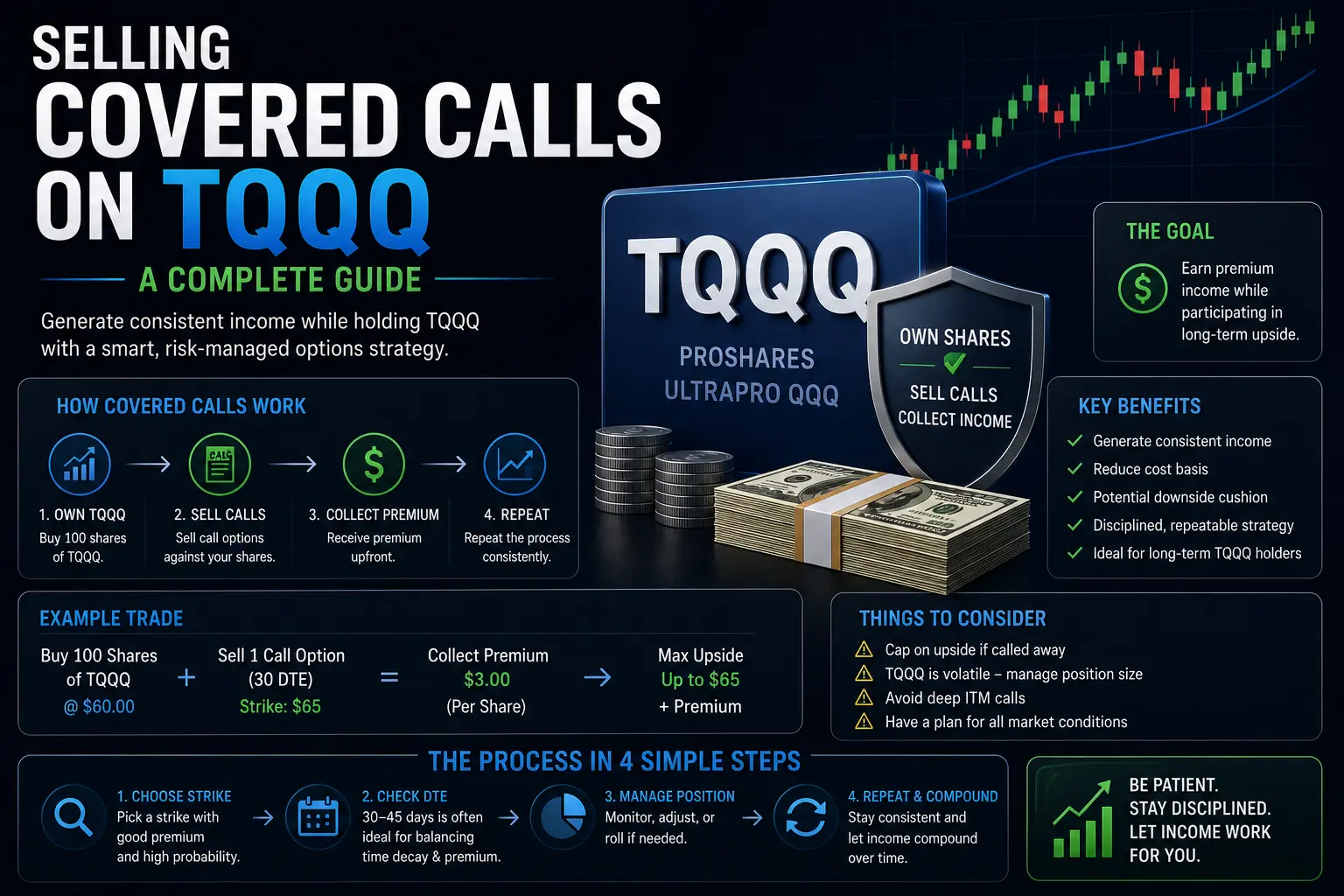
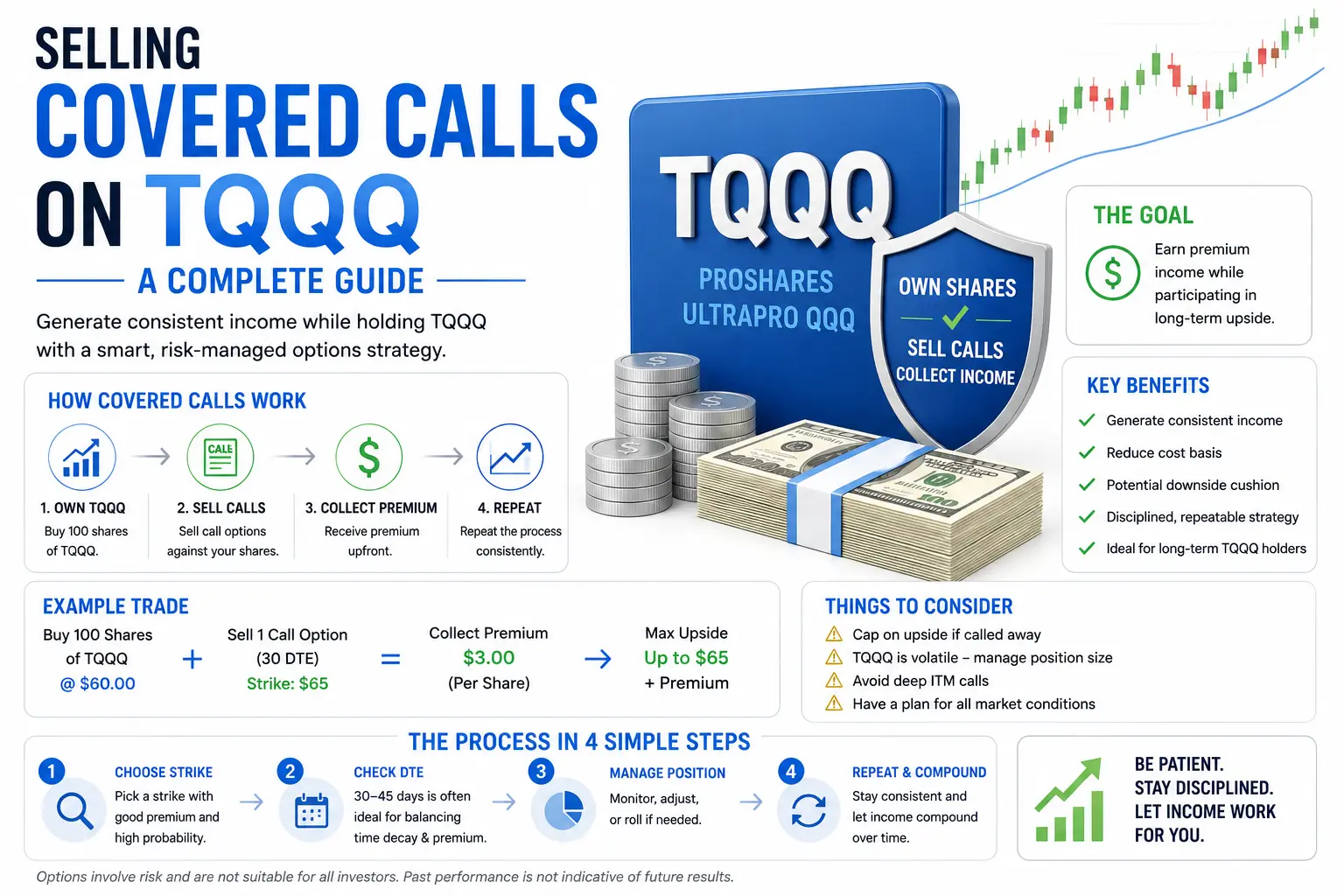
A covered call is a straightforward strategy: you own 100 shares of the underlying asset and sell one call option contract against it. The buyer of that call has the right to purchase your shares at the agreed strike price before expiration. In exchange, you receive a premium upfront.
For TQQQ specifically, the numbers look attractive. As of April 2026, TQQQ’s 30-day implied volatility runs around 55-60% (IV percentile approximately 60%), compared to roughly 18-22% for QQQ and 15-18% for SPY. Higher implied volatility means higher option premiums - which is the primary reason traders sell covered calls on TQQQ rather than on less volatile underlyings.
A Concrete Example
Assume TQQQ is trading at $75 per share. You own 100 shares (cost: $7,500). You sell one call option:
- Strike: $80 (approximately 6.7% OTM)
- Expiration: 30 days out
- Premium received: approximately $2.50 per share ($250 per contract)
That $250 represents a 3.3% return on your position in 30 days if the trade goes as planned. Annualized, that is roughly 40% - which explains the appeal.
Three outcomes are possible at expiration:
TQQQ stays below $80: The option expires worthless. You keep the $250 premium and your 100 shares. You sell another call next month.
TQQQ rises above $80: Your shares are called away at $80. Your total proceeds are $8,000 (shares) + $250 (premium) = $8,250 on an original $7,500 investment - a 10% gain. The downside: if TQQQ rose to $90, you do not participate in that additional $10 of upside per share.
TQQQ falls significantly: The option expires worthless (you keep the premium), but your shares are worth substantially less. A $250 premium provides very limited protection against TQQQ’s potential drawdowns.
Understanding the Greeks on TQQQ Options
The Greeks measure how an option’s price responds to changes in the underlying, time, and volatility. On a leveraged ETF like TQQQ, they behave with more intensity than on standard underlyings.
Delta measures how much the option price changes for every $1 move in TQQQ. An at-the-money (ATM) call on TQQQ has a delta of approximately 0.50. A 5% OTM call might have a delta of 0.30-0.35. Because TQQQ itself moves roughly 3x the Nasdaq-100, a 2% move in QQQ translates to approximately 6% in TQQQ - and your delta exposure moves significantly during those swings. This makes position management more urgent than on a standard ETF.
Theta (time decay) works in your favor as a seller. Options lose value as expiration approaches, and you keep that decay as income. TQQQ’s high implied volatility means theta is larger in absolute dollar terms than on a comparable non-leveraged position. A 30-day ATM option on TQQQ decays faster in dollar terms than the same-delta option on QQQ.
Vega measures sensitivity to changes in implied volatility. As a call seller, rising IV hurts you - the option you sold becomes more expensive to buy back if you need to exit. TQQQ’s IV is persistently elevated and can spike sharply during tech sell-offs, Fed announcements, or during the earnings season of major Nasdaq-100 components (Apple, Microsoft, Nvidia, Meta). A volatility spike from 55% to 80% can significantly increase the value of the short call even if the underlying barely moves.
Gamma measures how quickly delta changes. Near expiration, gamma accelerates - meaning your position’s sensitivity to price moves increases rapidly in the final days before expiration. This is particularly relevant for TQQQ, which can move 5-10% in a single day. High-gamma, near-expiry positions on TQQQ require close monitoring.
Strike Selection: The Three Approaches
The strike you choose determines the balance between premium collected and upside participation. There is no objectively correct answer - it depends on your market view, income target, and risk tolerance.
Comparison at $75 TQQQ Price (30-Day Expiration, IV ~57%)
| Strike | Delta | Approx. Premium | Upside Cap | Protection Buffer |
|---|---|---|---|---|
| $75 ATM | ~0.50 | ~$4.50 ($450) | None | 6% of position value |
| $80 5% OTM | ~0.32 | ~$2.50 ($250) | $500 gain capped | 3.3% |
| $85 13% OTM | ~0.18 | ~$1.20 ($120) | $1,000 gain capped | 1.6% |
Note: These are illustrative approximations based on TQQQ’s IV range as of April 2026. Actual premiums vary with market conditions.
ATM calls generate the most premium and the most theta decay - but they cap your upside from day one and carry higher assignment risk in any market rally. They work best in sideways or mildly bearish markets.
5-7% OTM calls are the most common choice among TQQQ covered call sellers. They balance meaningful premium with some room for the position to appreciate before being called away. In calm markets, they expire worthless regularly. In strong rallies, you get called away with a solid gain.
10-15% OTM calls generate less premium but allow significantly more upside participation. For investors who primarily hold TQQQ for its long-term appreciation potential and use covered calls as a secondary income layer, wider OTM strikes make more sense - you are less likely to cap the gains that make holding TQQQ worthwhile in the first place.
Rolling: What to Do When the Trade Goes Against You
Rolling is the process of closing your existing short call and opening a new one with a later expiration date, a higher strike, or both. It is the most important management technique for covered call sellers.
Why you would roll: If TQQQ rallies sharply and your short call moves deep in-the-money (ITM), you face a choice. Accept assignment (your shares get called away at the strike price), or roll the position to avoid losing your shares.
How rolling works: Suppose you sold the $80 call and TQQQ is now at $88 with two weeks to expiration. Your $80 call has significant intrinsic value - it is now worth approximately $8.50 or more. You buy it back (at a loss relative to what you sold it for) and simultaneously sell a new call, perhaps the $90 strike expiring 30 days out, collecting fresh premium.
The goal is to collect enough new premium from the roll to offset the loss on buying back the original call. This is not always possible. If TQQQ has moved sharply and your call is deep ITM, rolling may cost more than the new premium you receive - meaning you are paying to extend and avoid assignment, not generating income.
When to roll and when to accept assignment: This is a judgment call. If your cost basis in TQQQ is well below the current price and assignment at the strike would generate a satisfactory overall profit, accepting assignment and reinvesting elsewhere is often cleaner. Rolling indefinitely to avoid assignment on a position that has moved significantly against you can lead to compounding losses on the buy-back side.
The TQQQ-specific complication: Because TQQQ is highly volatile, a position that requires rolling today may reverse dramatically by next week. Paying a significant debit to roll, only to see TQQQ fall 15% the following week, is a common frustration in this strategy.
The Tax Treatment - Details That Matter
Option income is taxed differently depending on how the position closes, and the rules have specific implications for covered calls. Source: IRS Publication 550 and Fidelity’s tax guidance on covered calls.
If the call expires worthless: The premium collected is treated as a short-term capital gain, regardless of how long you held the shares. Taxed at ordinary income rates.
If the call is assigned (exercised): The premium received is added to the sale price of the shares. The holding period of the shares determines whether the gain on the stock is short-term or long-term - but only if the covered call qualifies as a “qualified covered call.”
Qualified vs. non-qualified covered calls: This distinction is crucial and often overlooked. A covered call is qualified if it is not deep in-the-money and the strike meets IRS guidelines based on share price. Qualified covered calls do not interrupt the holding period of the underlying shares - meaning if you have held TQQQ for over a year and sell a qualified OTM covered call, your long-term capital gains status is preserved if assigned. Non-qualified covered calls (typically deep ITM) suspend the holding period while the call is open.
The tax straddle problem: If a non-qualified covered call is sold against a TQQQ position held less than one year, the holding period for those shares is terminated. You start again at zero for long-term gains purposes. For a volatile instrument like TQQQ where many investors are actively trading in and out, this can mean an unexpected short-term gains bill.
The practical implication: Most investors selling OTM covered calls on TQQQ are generating short-term capital gains from the premiums. If you are in a high tax bracket, the after-tax income from the strategy is meaningfully lower than the gross premium. Factor this into your return calculations.
The Real Risks - Written Plainly
This section deserves to be read carefully, not skimmed.
The Premium Does Not Protect You From TQQQ’s Drawdowns
If TQQQ falls 40% - which it has done multiple times in its history - a covered call seller who collected 3-4% monthly premium over the preceding three months has collected roughly 9-12% in cumulative income. Against a 40% decline in the underlying, that is a 28-31% net loss on the position. The premium is not a meaningful hedge against a serious drawdown. It is income in normal markets, not protection in bad ones.
The 2022 drawdown is the most relevant case study. TQQQ fell 81.66% from its peak. No covered call premium program generates enough income to buffer a loss of that magnitude.
Volatility Decay Works Against Long-Term Holders
TQQQ’s daily rebalancing creates volatility decay (also called beta slippage). In choppy, directionless markets, TQQQ can lose value even if the Nasdaq-100 ends the period roughly flat. A simple illustration: if QQQ falls 10% one day and rises 10% the next, it ends at 99% of its starting value. TQQQ falls 30% and rises 30%, ending at 91% of its starting value. The math of daily compounding works against holders in volatile sideways markets.
This means that even a covered call seller who successfully manages the option side of the trade can see the underlying erode in choppy conditions - and the premium collected may not compensate for that erosion.
Capping Your Upside on an Asset That Requires Large Gains to Recover Losses
This is the most structural problem with covered calls on TQQQ. Recovering from large drawdowns in a leveraged ETF requires massive subsequent gains - a 50% loss requires a 100% gain to recover. If you are systematically capping your upside through covered calls during a recovery period, you are limiting the very mechanism by which TQQQ compensates for its large losses. Sellers who capped their gains in 2020 and 2023 (strong recovery years) collected modest premiums while missing the explosive rallies that restored prior losses.
Volatility Spikes and Vega Risk
TQQQ’s implied volatility is not stable. It can jump from 50% to 90%+ during market dislocations - the COVID crash, the 2022 rate shock, sharp tech sell-offs. When IV spikes, the option you sold becomes more expensive. If you need to exit or roll, you are buying back a significantly more expensive option than you sold. This is the scenario where covered call sellers can face losses on both sides: the underlying falls, and the option they need to buy back costs more than expected.
Covered Calls on TQQQ vs. QQQ vs. SPY
| Factor | TQQQ | QQQ | SPY |
|---|---|---|---|
| Implied Volatility (approx.) | 55-65% | 18-22% | 15-18% |
| Monthly ATM premium (approx.) | 5-7% of price | 2-3% | 1.5-2% |
| Max historical drawdown | 81.66% | ~54% (2008) | ~55% (2008) |
| Volatility decay risk | High | Minimal | Minimal |
| Premium as buffer vs. drawdown | Very limited | Limited | Limited |
| Complexity of management | High | Moderate | Low |
The higher premium on TQQQ is compensation for higher risk, not a free lunch. QQQ and SPY covered calls generate less income but on a far more stable underlying. For most investors, covered calls on QQQ or SPY provide a cleaner income profile with substantially less downside exposure.
Who This Strategy Is - and Is Not - For
This strategy may be appropriate for investors who:
- Already own TQQQ and want to generate income from a position they intend to hold regardless
- Understand and accept TQQQ’s potential for severe drawdowns
- Have a clear plan for rolling or accepting assignment
- Are comfortable managing positions actively - this is not a set-and-forget strategy
- Have experience with options trading and understand the Greeks
- Treat TQQQ as a tactical position, not a core long-term holding
This strategy is not appropriate for investors who:
- Are new to options trading
- Cannot tolerate the possibility of an 80%+ drawdown in the underlying
- Are relying on the premium income to offset what they perceive as TQQQ’s downside risk
- Do not have time to monitor positions regularly
- Are holding TQQQ as a long-term retirement asset and cannot afford to cap its recovery potential
The covered call premium on TQQQ is high because the risk is high. That relationship is not a coincidence.
If You Decide to Proceed: A Practical Framework
For investors who understand the risks and choose to implement this strategy, here is a practical starting framework.
Position sizing. Keep TQQQ itself to a maximum of 5-10% of your total portfolio. The covered call does not change the underlying risk of the position - it only adds an income layer on top. Sizing appropriately means that even an 80% drawdown in TQQQ has a manageable impact on your overall portfolio.
Strike selection. Start with 5-10% OTM strikes. This gives you meaningful premium while preserving some upside participation and reducing the frequency of rolling decisions.
Expiration. 21-45 days to expiration captures the steepest part of theta decay while giving you enough time to react to large moves. Avoid very short-dated options (under 7 days) on TQQQ - gamma risk near expiry on a highly volatile underlying requires constant monitoring.
Rolling discipline. Decide in advance at what point you will roll versus accept assignment. A simple rule: if the short call reaches 80% of maximum profit (i.e., you have collected 80% of the premium and it is early in the expiration cycle), buy it back and sell a new one. Do not wait until expiration if the position has moved significantly.
Keep a cash buffer. Maintain enough cash in your account to buy back the short call quickly if TQQQ makes a sharp move. Illiquidity in a fast-moving market is the enemy of any options seller.
Track your net P&L on the combined position (shares + option), not just the option premium. A month where you collected $300 in premium while your shares fell $800 is a net losing month, even if the option trade “worked.”
Summary
Selling covered calls on TQQQ generates premium income that is genuinely higher than on almost any comparable ETF. The strategy has a clear mechanical logic: collect elevated premiums from TQQQ’s high implied volatility, repeat monthly, and build an income stream on top of your position.
The risks are also genuine and significant. TQQQ’s 81.66% historical drawdown, daily volatility decay mechanism, and potential for sharp IV spikes all create risks that no amount of premium income meaningfully offsets in a serious bear market. The strategy works best in sideways to moderately bullish markets with stable volatility - precisely the conditions where TQQQ itself is already reasonably stable.
For investors who own TQQQ with open eyes, understand the leverage decay, and want to extract additional value from the position through premium income, covered calls can serve a purpose. For investors who are considering buying TQQQ primarily as a platform for selling calls, the underlying risk profile deserves very careful consideration before the first trade.
The premium is high for a reason.
This article is for educational purposes only and does not constitute financial, investment, or tax advice. Options trading involves significant risk and is not suitable for all investors. Past performance of TQQQ and options strategies does not guarantee future results. TQQQ maximum drawdown data sourced from PortfoliosLab (portfolioslab.com). Tax treatment based on IRS Publication 550 and Fidelity’s tax guidance on covered calls, current as of May 2026. Consult a qualified financial advisor and tax professional before implementing any options strategy.
Frequently Asked Questions
Is selling covered calls on TQQQ a safe income strategy? No. The word “safe” does not apply to any strategy involving TQQQ. The premium income is real, but it does not meaningfully protect against TQQQ’s potential for severe drawdowns. In 2022, TQQQ fell 81.66% from its peak. No covered call premium program offsets a loss of that magnitude. The strategy generates income in normal market conditions - it does not transform a high-risk instrument into a conservative one.
How much premium can I realistically collect monthly? At an implied volatility of 55-60% (TQQQ’s approximate range in early 2026), a 5% OTM call expiring in 30 days generates roughly 2.5-4% of the underlying’s price in premium. On a $7,500 position (100 shares at $75), that is approximately $190-$300 per month. Actual amounts vary significantly with IV levels, which can spike or compress rapidly.
What happens if TQQQ is called away? Your shares are sold at the strike price. You keep the premium and receive the strike price per share. Your total proceeds are (strike price × 100 shares) + premium collected. Whether this is a good outcome depends on your cost basis. If TQQQ has risen far above your strike, you miss the additional upside - the most common frustration with covered calls on a volatile, upward-trending ETF.
Should I sell covered calls every month on TQQQ? There is no obligation to sell a call every month. Many experienced covered call sellers skip months when implied volatility is low (premium not worth the upside cap) or when they expect a strong directional move in the underlying. Mechanical monthly selling without regard to market conditions is not necessarily optimal.
How does volatility decay affect my covered call strategy? Volatility decay hurts the long TQQQ position over time in choppy markets. If TQQQ’s underlying index moves sideways but with high daily volatility, the ETF can lose value even as the index ends flat. The covered call premium does not offset this structural drag. It is one reason why holding TQQQ long-term as a covered call platform - rather than a tactical position - requires careful consideration.
Can I use this strategy in a retirement account (IRA)? Covered calls are permitted in IRAs at most major brokers. The tax treatment differs: gains in a traditional IRA are tax-deferred and taxed at ordinary income rates on withdrawal; gains in a Roth IRA are tax-free on qualified withdrawal. However, many retirement account holders should consider whether TQQQ is appropriate for retirement assets given its drawdown potential - that question is separate from and more fundamental than the covered call mechanics.