
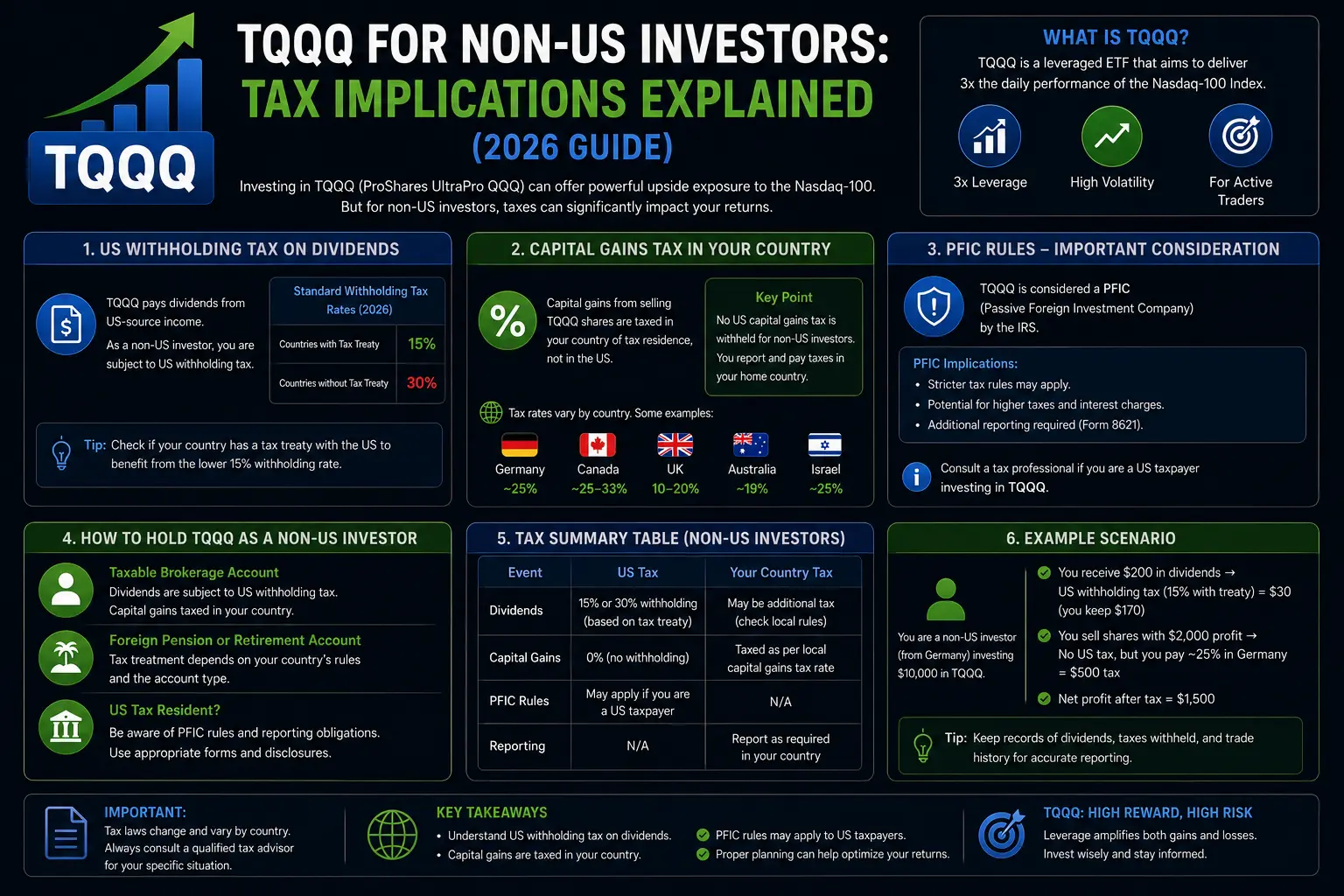
TQQQ for Non-US Investors: Tax Implications Explained (2026 Guide)
If you’re investing in US markets from outside the US, understanding taxes is not optional — it directly impacts your real returns.
TQQQ is widely discussed for its high returns potential. But most tax guides are written for US residents.
For international investors, the tax picture is different — and in some ways, more efficient.
👉 I personally used TQQQ (with options) during a recovery after a 70% drawdown. Full case study here.
This guide breaks down exactly how TQQQ is taxed for non-US investors:
- Dividends
- Capital gains
- Options income
- Hidden risks most people ignore
⚠️ Important Disclaimer: Tax rules vary by country and individual circumstances. This guide is for educational purposes only — always verify with a qualified tax advisor in your jurisdiction.
What Kind of Income Does TQQQ Generate?
TQQQ produces three types of income:
1. Dividends
- Paid quarterly
- Very low yield (typically under 1%)
- Subject to US withholding tax
2. Capital Gains Distributions
- Occasional distributions from the ETF
- Taxable even if you don’t sell
3. Capital Gains from Selling
- Your main profit source
- Realized when you sell shares
US Tax Treatment for Non-US Investors
Dividends: Withholding Tax Applies
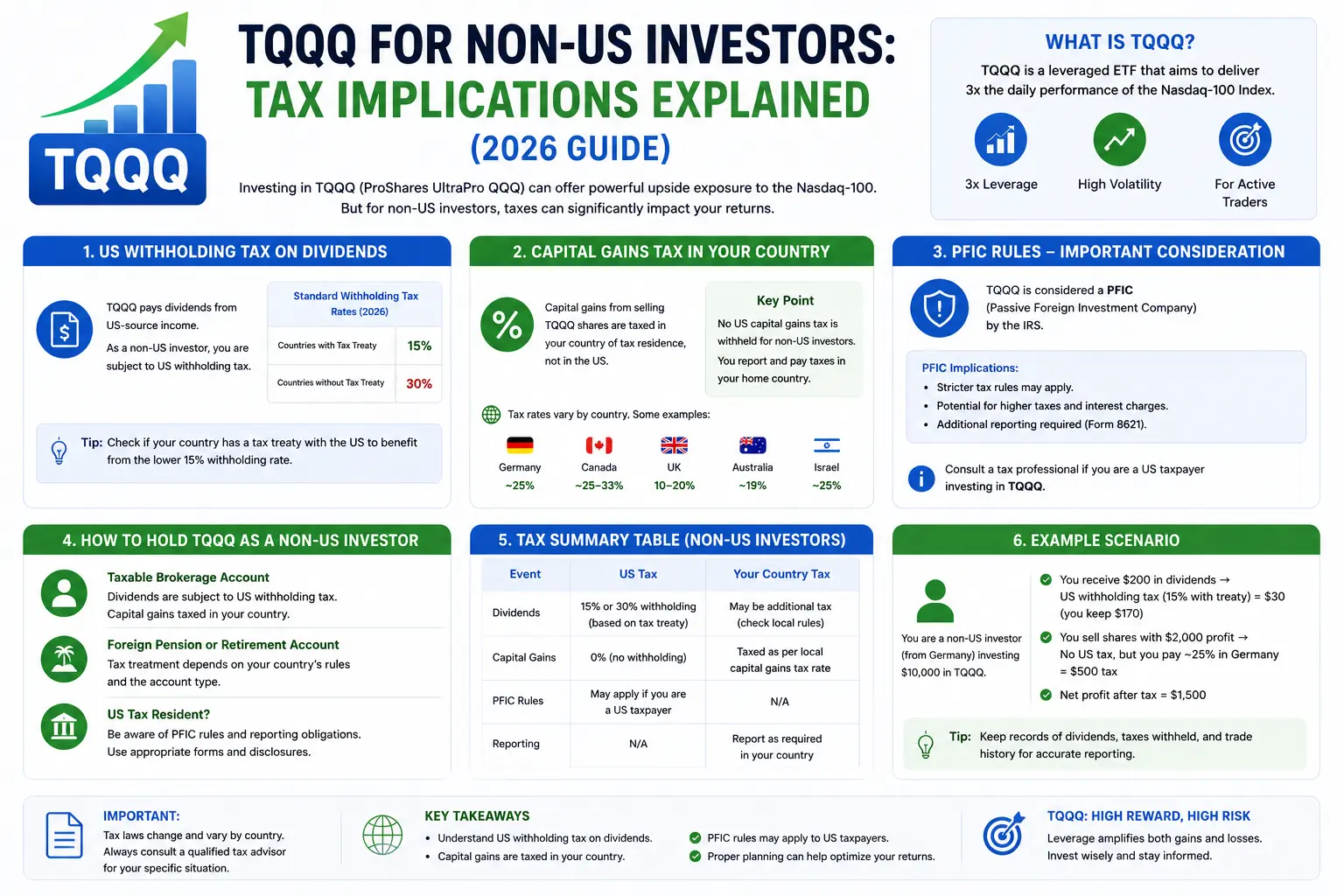
TQQQ dividends are subject to US withholding tax.
Typical rates with a valid W-8BEN form:
Country | Withholding Rate |
|---|---|
Israel | 25% (treaty rate — not a large reduction vs default) |
UK / Germany / France | 15% |
Australia | 15% |
No treaty | 30% |
Because TQQQ’s yield is low, the actual dollar impact is small even at 25%.
Example:
- $50,000 position
- 0.5% yield → $250 income
- 25% tax → $62.50 withheld
Capital Gains: No US Withholding
In most cases, non-US investors are not subject to US tax on capital gains from selling ETFs like TQQQ.
That means:
- No US withholding when you sell
- Full proceeds credited to your account
You are responsible for taxes in your home country.
Home Country Tax (Examples)
Israel
- Dividends: 25% (covered via US withholding + tax credit)
- Capital gains: 25% locally
Example:
- Buy at $40 → sell at $100
- Gain: $60 per share
- Tax: $15 | Net: $45
Canada
- 50% of gains are included in taxable income at your marginal rate
⚠️ Effective rate varies widely by income bracket — consult a Canadian tax advisor for your specific situation.
Australia
- Capital gains taxed at marginal rate
- 50% discount if held more than 12 months
The Hidden Risk: US Estate Tax
This is one of the most overlooked issues.
Non-US investors may be exposed to US estate tax on US-domiciled assets like TQQQ.
Key points:
- Threshold: ~$60,000 for non-residents
- Tax rates: up to 40%
- Applies upon death — not on trading
⚠️ Verify the current threshold — this is subject to change based on US tax legislation.
This does not affect trading — but it matters for long-term holders. If you plan to hold large US positions long-term, this risk should not be ignored.
The Tax Efficiency Advantage of TQQQ
TQQQ has one major advantage: low dividend yield = low withholding drag.
ETF | Yield | Withholding | Annual Drag |
|---|---|---|---|
TQQQ | 0.5% | 25% | 0.125% |
QQQ | 0.6% | 25% | 0.15% |
SCHD | 3.5% | 25% | 0.875% |
JEPI | 7.5% | 25% | 1.875% |
Conclusion: Growth-focused ETFs like TQQQ are more tax-efficient than income ETFs for non-US investors.
Options Income: Advanced but Efficient
If you use strategies like covered calls or cash-secured puts, you generate premium income.
In many jurisdictions:
- Treated similarly to capital gains
- No US withholding applies
However:
- Tax treatment varies by country
- Frequent trading increases taxable events locally
👉 Bottom line: Efficient structure — but requires tracking and discipline.
Practical Tax Reporting
If you use a US broker, you’ll typically receive:
Key Documents
- Form 1042-S → US income + tax withheld
- Annual statement → all activity
- Trade confirmations
What You Report
- Dividends (gross amount + tax credit)
- Capital gains
- Options income
Common Mistakes to Avoid
- Not submitting W-8BEN → 30% withholding instead of treaty rate
- Ignoring cost basis tracking
- Missing capital gain distributions
- Assuming all tax rules are identical across countries
- Overtrading → increases local tax burden
Choosing the Right Broker
Execution matters more than most people think. You need:
- Access to US markets
- Accurate tax reporting
- Low fees
- Reliable tax documents
👉 We recommend IBKR for most non-US investors — here’s our full review.
IBKR offers global access, strong reporting tools, and supports advanced strategies like options.
Final Thoughts
From a tax perspective, TQQQ is relatively efficient for non-US investors.
Low dividend yield → minimal withholding
No US capital gains tax → profits taxed locally
👉 Tax doesn’t disappear — it shifts. You’re not avoiding tax. You’re moving the obligation from the US to your home country. Used correctly, this is efficient. Used blindly, it creates problems.