
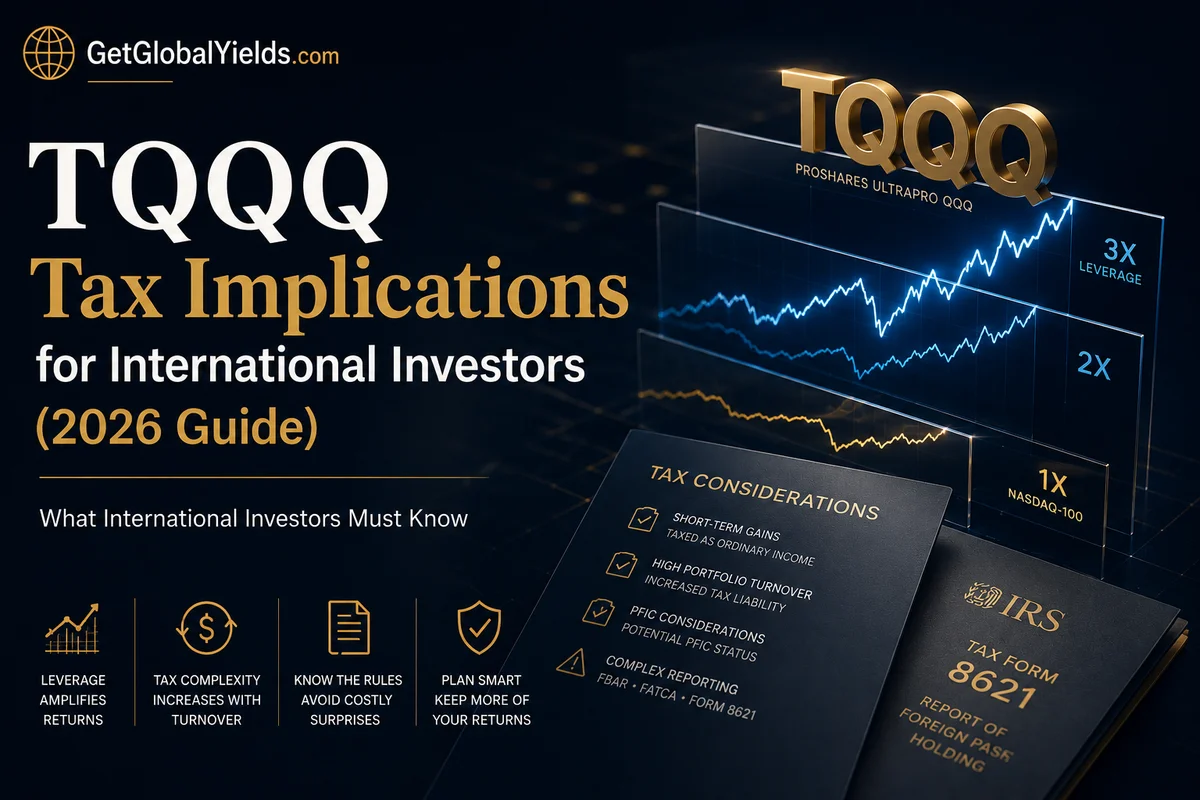
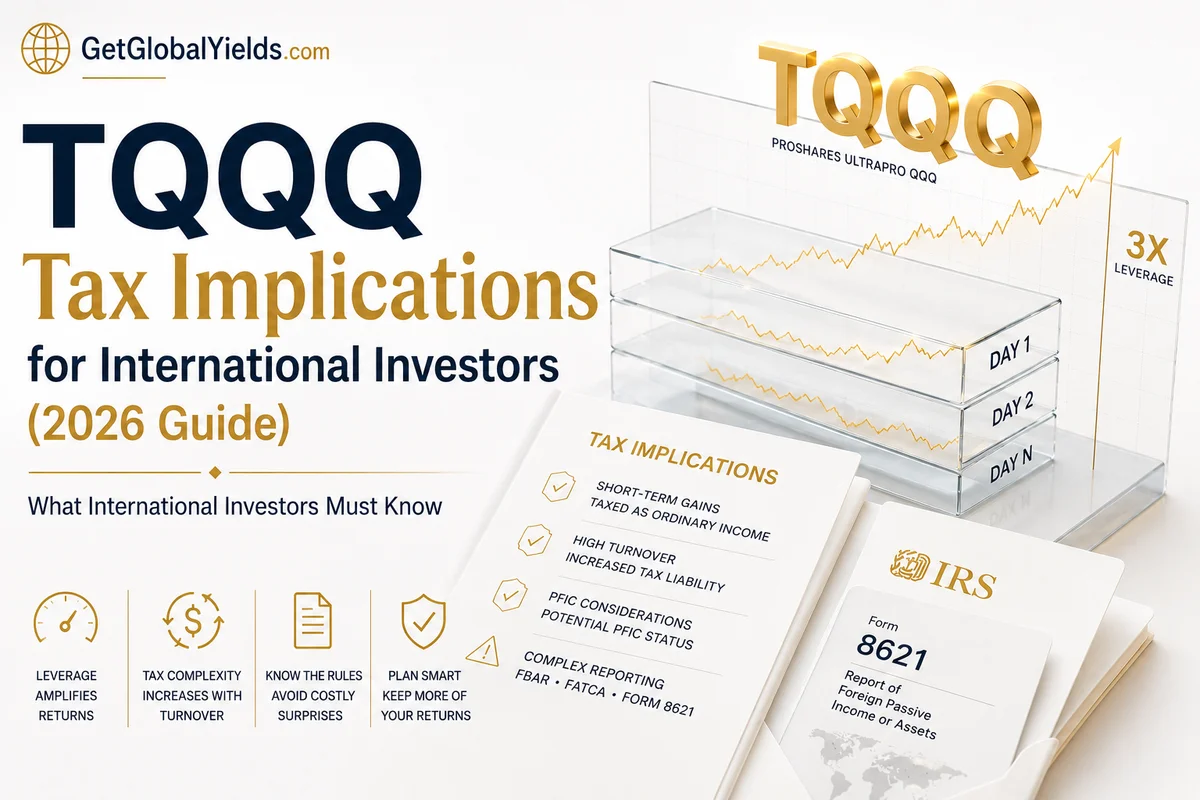
TQQQ for International Investors: Tax Implications (2026)
Updated: May 2026 • GetGlobalYields.com • Read time: ~9 min
💡 Bottom Line
TQQQ is a US-domiciled ETF, so international investors face standard US withholding rates on dividends (30% default, 15% with treaty). Capital gains are generally not taxed by the US for non-residents.
But TQQQ’s unique structure - a 3x leveraged ETF that uses swaps - creates additional tax considerations in your home country. This guide covers what international investors need to know about TQQQ taxation in 2026.
📌 TQQQ Basics: What Makes It Different
TQQQ (ProShares UltraPro QQQ) is a 3x leveraged ETF that aims to deliver 3x the daily return of the NASDAQ-100 Index. Unlike traditional ETFs that hold the underlying stocks, TQQQ uses financial derivatives (swaps, futures) to achieve its leverage.
Key tax-relevant characteristics:
- US-domiciled: Incorporated in the US, not a PFIC for most investors
- Derivative-based: Uses total return swaps rather than direct stock ownership
- Daily reset: Leverage is reset each trading day (affects long-term compounding)
- Low dividend yield: ~0.5% annually (reduces withholding tax impact)
For international investors, the main tax questions are:
- How are TQQQ dividends taxed by the US?
- How are capital gains treated?
- How does my home country tax TQQQ’s unique structure?
📊 US Tax Treatment for Non-Residents
Dividends: 15% Withholding (With Treaty)
TQQQ pays quarterly dividends. As a non-US investor:
- Default rate: 30% US withholding on dividends
- Treaty rate: 15% if you file W-8BEN and your country has a tax treaty
- Effective yield after tax: ~0.43% (15% of 0.5%)
Example: $10,000 TQQQ position generates ~$50 in annual dividends. With 15% withholding, you receive ~$42.50, and $7.50 goes to the US Treasury.
Capital Gains: Generally Tax-Free in US
When you sell TQQQ shares:
- US tax: 0% for non-residents (treaty protection)
- Home country tax: Depends on your local laws (often 15-25%)
- Reporting: You may need to report the sale to your home tax authority
This is a significant advantage: you can realize large gains in TQQQ without owing US capital gains tax. You only pay tax in your country of residence.
No PFIC Concerns (Usually)
TQQQ is a US-domiciled ETF, not a foreign corporation. This means it’s not a Passive Foreign Investment Company (PFIC) for US tax purposes.
Exception: If you’re a US person (citizen, green card holder) living abroad, different rules apply. But for non-US investors without US tax obligations, PFIC rules don’t concern TQQQ.
🌍 Country-Specific Considerations
Israeli Investors
Dividends: 15% US withholding (US-Israel treaty rate) Capital gains: 25% Israeli tax on real gains (adjusted for inflation) Reporting: Must report TQQQ holdings and transactions to Israeli Tax Authority Foreign tax credit: Can claim credit for 15% US dividend withholding
Important: Israel taxes “real gains” - adjusted for inflation using the Consumer Price Index. This can significantly reduce your taxable gain in high-inflation periods.
Canadian Investors
Dividends: 15% US withholding (US-Canada treaty rate) Capital gains: 50% inclusion rate at marginal tax rate TFSA/RRSP: TQQQ can be held in registered accounts, but derivatives-based ETFs have specific rules Currency: CAD-USD exchange rate affects cost basis calculations
Note: Some Canadian brokers may restrict leveraged ETF trading or require additional disclosures.
Australian Investors
Dividends: 15% US withholding (US-Australia treaty rate) Capital gains: CGT discount (50% after 12 months) for individuals Franking credits: Don’t apply to US dividends Reporting: Must convert USD amounts to AUD for tax reporting
Consideration: Australia’s CGT regime is relatively favorable for long-term holdings.
European Investors
Dividends: 15% US withholding (most EU countries have treaties) Capital gains: Varies by country (0-30% typically) UCITS alternative: Some European investors use UCITS-compliant leveraged ETFs (higher fees, different tax treatment) Estate tax: US estate tax may apply to holdings over $60,000 (treaty exemptions vary)
⚠️ Special Tax Considerations for Leveraged ETFs
1. Dividend Characterization
TQQQ dividends may be classified differently than traditional stock dividends in some countries. They could be treated as:
- Ordinary dividend income (most common)
- Return of capital (less likely)
- Interest-like payment (due to swap structure)
Check with a local tax advisor about how your country treats leveraged ETF distributions.
2. Derivative Taxation
Some countries tax derivative-based investments differently than direct stock holdings. TQQQ’s use of total return swaps might trigger:
- Different tax rates
- Different reporting requirements
- Different loss treatment
3. Currency Conversion
TQQQ trades in USD. If your home currency isn’t USD:
- You have currency gain/loss on your initial investment
- Dividends are received in USD, converted to local currency
- Cost basis must be tracked in both currencies for tax reporting
4. Wash Sale Rules (US Persons Only)
If you’re a US person, TQQQ is subject to US wash sale rules. Non-US investors generally don’t need to worry about this unless they have US tax filing obligations.
📋 Step-by-Step: Tax Reporting for TQQQ
1. Dividend Reporting
What to track:
- Gross dividend amount (USD)
- US tax withheld (15%)
- Net dividend received (USD)
- Local currency equivalent (using exchange rate on payment date)
Example record:
Date: 2026-03-25
Gross dividend: $12.50
US withholding: $1.88 (15%)
Net received: $10.62
Exchange rate: 1 USD = 3.65 ILS
ILS equivalent: 38.76 ILS
2. Sale Reporting
What to track:
- Purchase date and price (USD)
- Sale date and price (USD)
- Gain/loss in USD
- Exchange rates at purchase and sale
- Gain/loss in local currency
Important: Many countries require using specific exchange rates (average annual rate, spot rate on transaction date, etc.).
3. Foreign Tax Credit
If your country taxes the gross dividend (before US withholding), you can usually claim a foreign tax credit for the 15% US tax paid.
How it works:
- Report gross dividend as income
- Claim credit for US tax withheld
- Pay local tax on the net amount
💰 Tax-Efficient TQQQ Strategies
1. Hold Long-Term for Capital Gains Treatment
Many countries tax long-term capital gains at lower rates than dividends or short-term gains. Holding TQQQ for extended periods (1+ years) can be tax-efficient if your country has preferential long-term rates.
2. Use Tax-Advantaged Accounts (If Available)
Some countries offer tax-advantaged investment accounts:
- Israel: Keren Hishtalmut (limited contribution, tax-free after 6 years)
- Canada: TFSA (tax-free), RRSP (tax-deferred)
- UK: ISA (tax-free)
- Australia: Superannuation (concessional tax)
Check if leveraged ETFs are permitted in these accounts and understand any restrictions.
3. Tax-Loss Harvesting
If TQQQ declines in value, you can sell to realize a loss for tax purposes, then potentially repurchase after a waiting period (check local wash sale rules).
Caution: TQQQ is volatile. Tax-loss harvesting opportunities exist, but timing is challenging.
4. Currency Hedging Considerations
If you’re concerned about USD-ILS (or other currency) fluctuations, consider:
- Natural hedging (matching USD assets with USD liabilities)
- Currency-hedged accounts (some brokers offer)
- Separate currency hedging strategies
Remember: Currency gains/losses are often taxable events.
❓ Frequently Asked Questions
Is TQQQ a PFIC for non-US investors?
No. TQQQ is a US-domiciled ETF, not a foreign corporation. PFIC rules only apply to foreign investment companies. Non-US investors without US tax obligations don’t need to worry about PFIC for TQQQ.
Do I need to file a US tax return for TQQQ gains?
Generally no. If you’re a non-resident with only dividend income subject to withholding and capital gains from US stocks, you don’t need to file a US return. The withholding is your final US tax liability.
How are TQQQ’s swap payments taxed?
TQQQ doesn’t distribute swap payments to shareholders. The swap costs are embedded in the fund’s expense ratio (0.88%). You don’t receive separate swap income, so there’s no additional tax reporting for swap payments.
Can I hold TQQQ in an Israeli Keren Hishtalmut?
Possibly, but check with your Keren Hishtalmut provider. Some Israeli investment houses restrict leveraged or derivative-based ETFs. Even if permitted, understand that Keren Hishtalmut has contribution limits and withdrawal rules.
What happens if I die with TQQQ holdings?
US estate tax may apply to US securities owned by non-residents. The exemption is $60,000 (unless a treaty provides higher). Israeli investors: Israel has an estate tax treaty with the US that may provide some protection. Consult an estate planning professional.
🏁 Action Steps for International TQQQ Investors
- File W-8BEN with your broker to get 15% dividend withholding (instead of 30%)
- Track all transactions in USD and local currency
- Understand your country’s treatment of leveraged ETF dividends and capital gains
- Consider holding period for preferential tax rates
- Consult a local tax advisor familiar with US securities and derivative taxation
- Review estate planning for US securities holdings
TQQQ can be a powerful tool for international investors seeking leveraged NASDAQ exposure. Understanding the tax implications helps you keep more of your returns and avoid surprises at tax time.
🔗 Related Articles on GetGlobalYields.com
→ The Wheel Strategy on TQQQ: A Step-by-Step Guide
→ How to Hedge TQQQ: Protection Strategies for Leveraged ETFs
→ Compounding Returns with TQQQ: Long-Term Projections
→ US-Israel Tax Treaty: Capital Gains & Dividend Rates (2026)
→ Interactive Brokers 2026 Review: The Best Broker for International Investors
⚠️ Affiliate Disclosure: GetGlobalYields.com may earn a commission if you open an account through links on this page. This does not affect our editorial independence.
⚠️ Tax Disclaimer: This article is for informational purposes only and does not constitute tax or financial advice. Tax treatment of leveraged ETFs varies by country and individual circumstances. Consult a qualified tax professional for guidance specific to your situation.