
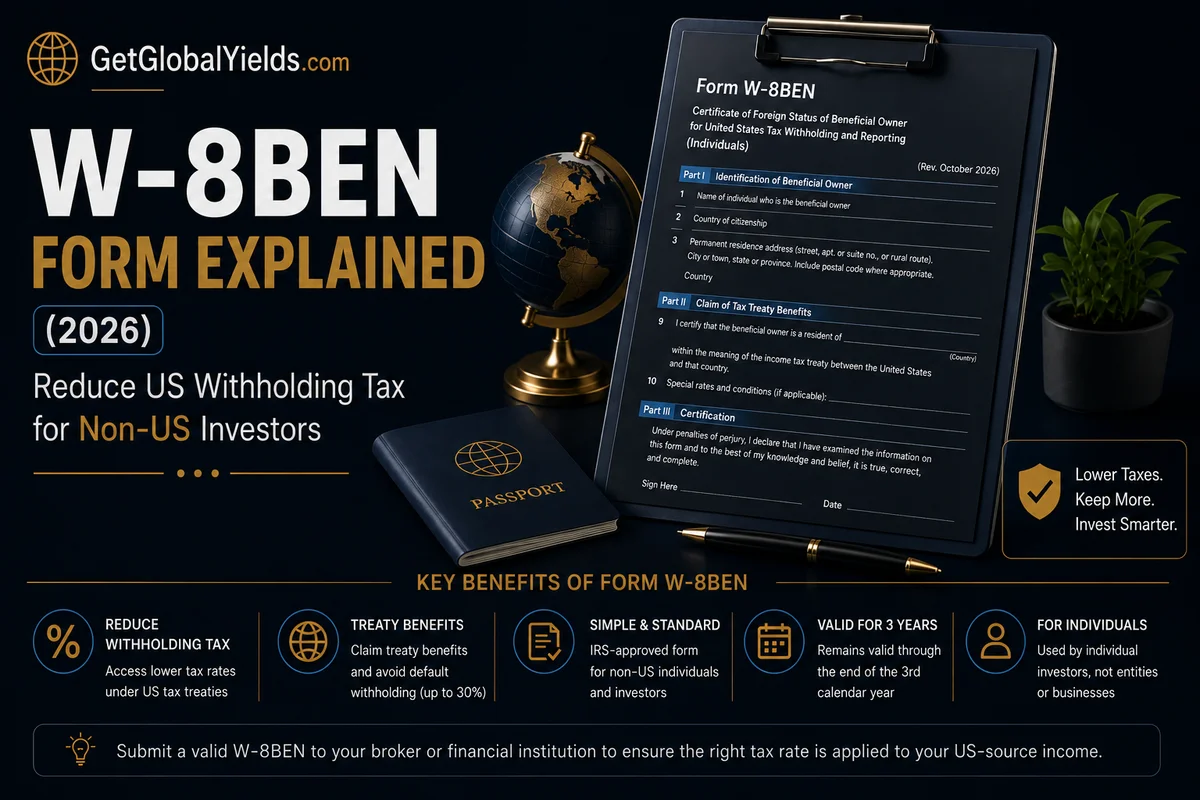
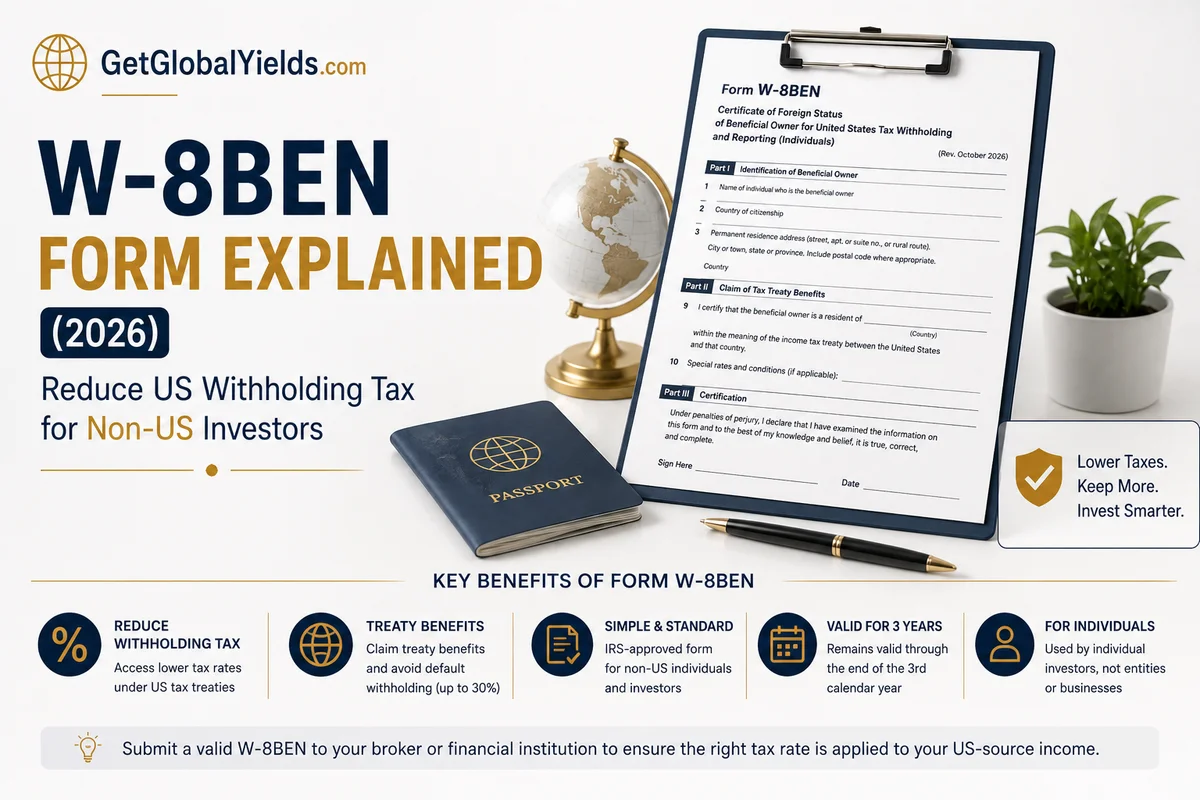
W-8BEN Form Explained (2026)
If you invest in US stocks or ETFs as a non-US resident, one form directly determines how much of your returns you actually keep: the W-8BEN.
Without it, the IRS withholds 30% of your dividends and certain types of interest. With it, and with the correct tax treaty applied, that rate drops to 15% for most countries and 25% for Israeli investors.
Over time, that difference compounds into thousands of dollars.
This guide explains exactly how the W-8BEN works, how to fill it out correctly, what mistakes cost investors money, and how it fits into a broader tax-efficient strategy for international investors.
Want practical cross-border investing updates every week? Join our newsletter and get new broker, tax, and strategy breakdowns as they are published.
What Is the W-8BEN Form?
The W-8BEN (Certificate of Foreign Status of Beneficial Owner for United States Tax Withholding and Reporting) is an IRS form used by non-US investors to:
- Confirm they are not US persons
- Claim tax treaty benefits
- Reduce US withholding tax on dividends and interest
You do not send this form to the IRS. You submit it directly to your broker, and the broker applies the correct withholding rate automatically.
Why the W-8BEN Matters
Without a valid W-8BEN:
- The IRS applies a flat 30% withholding
- No treaty benefits are applied
- Your returns are permanently reduced unless you file complex recovery claims
Example: $200,000 Portfolio
Assume:
- Dividend yield: 2%
- Annual dividends: $4,000
| Scenario | Withholding Rate | Tax Paid | You Keep |
|---|---|---|---|
| No W-8BEN | 30% | $1,200 | $2,800 |
| Israel (treaty) | 25% | $1,000 | $3,000 |
| UK / EU | 15% | $600 | $3,400 |
Difference vs no form:
- Israel: +$200/year
- UK/EU: +$600/year
Over 10+ years, this becomes a meaningful drag on performance.
Who Needs the W-8BEN?
You need this form if:
- You are not a US citizen or green card holder
- You invest in US stocks, ETFs, or bonds
- You receive (or expect to receive) dividends or interest
This applies to almost all international investors using brokers like Interactive Brokers, tastytrade, Firstrade, and Schwab International.
Who does not need it:
- US citizens use W-9
- US tax residents use W-9
- Entities (companies, trusts) use W-8BEN-E
Tax Treaty Rates (2026)
| Country | Default | Treaty Rate |
|---|---|---|
| Israel | 30% | 25% |
| Canada | 30% | 15% |
| UK | 30% | 15% |
| Germany | 30% | 15% |
| France | 30% | 15% |
| Australia | 30% | 15% |
| Japan | 30% | 10% |
| India | 30% | 25% |
| Brazil | 30% | 30% (no treaty) |
| Singapore | 30% | 30% (no treaty) |
Always verify current treaty rates because they can change.
How to Fill Out the W-8BEN
Most brokers (especially Interactive Brokers) embed this digitally during signup.
Part I - Identification
- Name: As in passport
- Country of citizenship: Passport country
- Address: Your real residence (no PO box)
- Foreign TIN: Required (for example, Israeli ID number)
- US TIN: Usually not required
Part II - Tax Treaty Claim
- Enter your country of residence
- Claim treaty benefits (your broker usually pre-fills this)
Example for Israel:
Resident of Israel claiming Article 10 - 25% dividend rate.
Part III - Certification
Sign and date.
Common Mistakes
- Not submitting the form -> automatic 30% withholding
- Missing Foreign TIN -> treaty benefits often rejected
- Wrong address -> can invalidate the form
- Letting it expire -> reverts to 30%
- Claiming wrong treaty rate -> rejection or incorrect withholding
Expiration Rules
The W-8BEN is valid for 3 full calendar years plus the current year.
Example: signed in 2026, valid until Dec 31, 2029.
After expiration, your broker typically reverts to 30% withholding.
What It Covers (and Doesn’t)
Covers:
- Dividends
- Interest
- Certain distributions
Does not cover:
- Capital gains
- Your local taxes
For most non-US investors, US capital gains tax is generally 0% and tax is paid in the home country.
Estate Tax Risk
US estate tax risk is often ignored but important for international investors.
- US estate tax can apply above about $60,000
- Rates can reach 40%
- The W-8BEN does not protect you from estate tax exposure
Common mitigation strategies include portfolio structuring and use of non-US-domiciled funds where appropriate.
Strategy Impact
High dividend strategies:
- Direct yearly tax drag from withholding
Growth strategies (for example, QQQ / TQQQ):
- Lower dividend impact
- More return from capital appreciation
Options strategies:
- Premium income is often not subject to US withholding
- Usually taxed locally based on your tax residency
Choosing the Right Broker
The W-8BEN is only as good as how your broker handles it.
What to look for:
- Digital submission
- Automatic treaty application
- Accurate Form 1042-S reporting
- Proper income classification
Many international investors prefer Interactive Brokers because the W-8BEN flow is integrated end-to-end.
Open an account with Interactive Brokers: Interactive Brokers (IBKR) (affiliate link)
Also read:
FAQ
Do I send this to the IRS?
No. Your broker handles it.
Can I fix mistakes?
Yes. Submit a new form.
No treaty country?
The default 30% applies.
Does it affect capital gains?
No.
Summary
- W-8BEN reduces withholding from 30% to treaty rates
- Required for non-US investors receiving dividends
- Must include a Foreign TIN in most cases
- Expires every three years (plus current year rule)
- Does not change capital gains treatment
- Does not protect against estate tax risk
This is one of the simplest actions that can directly improve your net returns.
If you invest in US markets and do not have this form correctly filed, you may be paying more tax than necessary.
Next steps:
- Start here: Best Brokers for Israeli Investors in US Markets
- Learn more: TQQQ tax guide for international investors