
Most Australians who want to buy Apple or Nvidia spend too long asking whether they are allowed to, and almost no time thinking about what it will actually cost them.
The first question has a short answer: yes, Australians can buy US stocks freely. No restrictions, no special approvals, no US address required. The second question is where the real money is either kept or quietly lost - and it comes down to one number most brokers bury in the fine print.
That number is the FX conversion fee. Every time you move AUD into USD to fund a US brokerage account, your broker takes a cut. The difference between the cheapest and most expensive platforms on this list is over $480 on a single $50,000 deposit. Do that annually for ten years and reinvest the difference, and you are talking about a gap that would make most investors choose differently.
Here is how to set it up properly - and how to make sure you are not the one leaving money on the table.
What You Need to Get Started
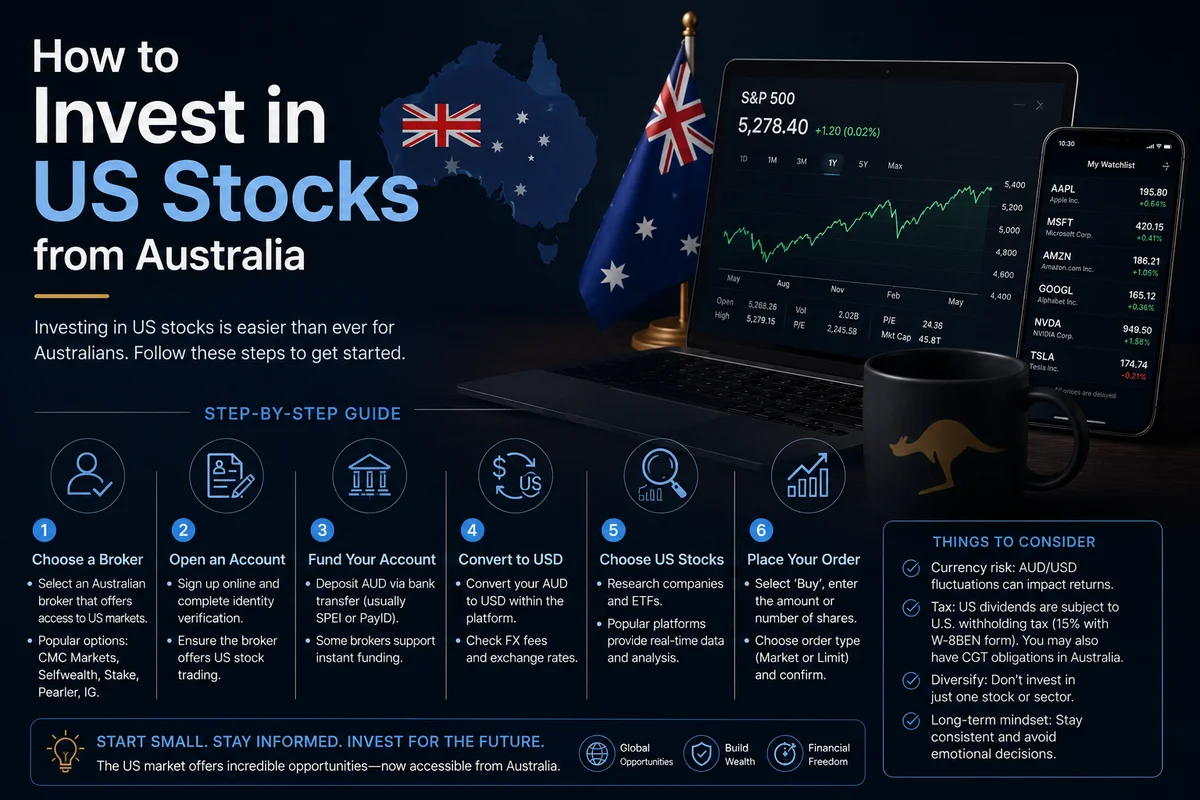
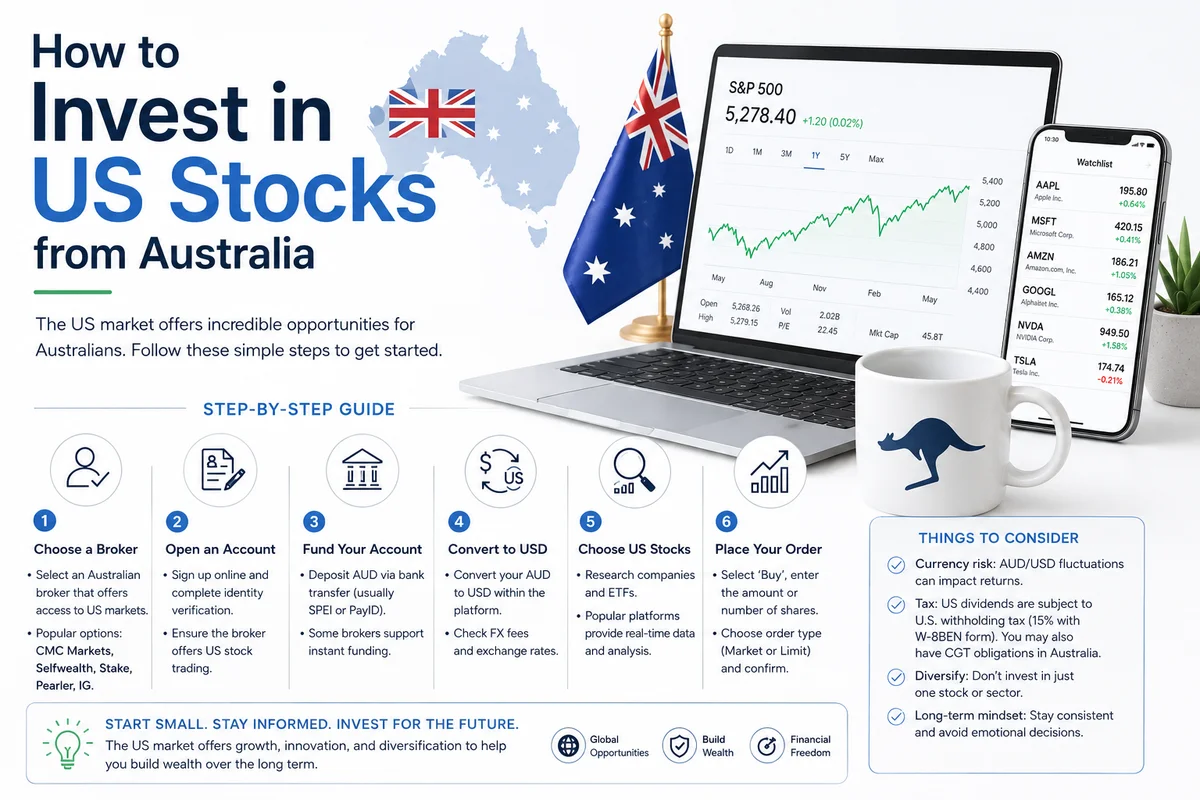
The setup is simpler than most people expect:
- An ASIC-regulated brokerage account with US market access
- Standard identity verification - Australian passport or driver’s licence
- A completed W-8BEN form (your broker handles this electronically during signup)
No US address. No US bank account. No US tax file number. Account opening is fully online for every platform in this guide, and most approvals come through within one to two business days.
The W-8BEN Form: Do Not Overlook This
The W-8BEN is an IRS form that certifies you are not a US taxpayer. Without it, the US withholds 30% of every dividend paid to you. With it - because Australia has a tax treaty with the US - that drops to 15%.
On a $100,000 portfolio yielding 2% annually, that is $300 per year sitting with the IRS instead of you, for nothing more than an uncompleted form.
Every major Australian broker handles the W-8BEN electronically during onboarding. What they do not always remind you: the form expires every three years. If your dividend payments suddenly look smaller than they should, check your W-8BEN status before anything else.
Choosing a Broker
Six platforms are worth serious consideration in 2026. They differ on three things that actually matter: the per-trade commission, the FX conversion fee, and how your assets are held.
On custody: CHESS sponsorship applies to ASX-listed securities only. US stocks held through any Australian broker sit in a custodial arrangement - standard across the entire industry. What matters is that the broker holds an ASIC licence and that you understand who their US clearing partner is.
Interactive Brokers (IBKR)
For anyone investing serious money and making regular contributions, IBKR is the answer - and the FX conversion is the reason.
Using manual FX conversion through the IBKR Client Portal’s “Convert Currency” tab, the fee is 0.002% with a minimum of USD $2.00. On a $10,000 AUD deposit, that is roughly AUD $3. On a $50,000 deposit, around AUD $14. Every other platform on this list charges between $250 and $500 for the same deposit.
One thing to get right from day one: IBKR also offers an auto-conversion service at 0.03% - fifteen times more expensive on large amounts. The manual process takes under a minute once you know where to find it. Use it every time.
The trading commission is USD $0.005 per share, minimum USD $1 per order. The Trader Workstation platform is powerful but not immediately intuitive. IBKR GlobalTrader, the mobile app, is a much cleaner entry point for investors who want to buy and hold.
CMC Invest
CMC Invest charges $0 commission on all US, UK, Canadian and Japanese stocks and ETFs - no conditions, no minimum trade count. The only cost is an FX spread of approximately 0.6% when you deposit AUD. You pay that once per deposit, then trade as many times as you want for free.
For active investors who make multiple trades per month from a single deposit, this structure is genuinely hard to beat. The minimum international order size is AUD $1,000, though a selection of popular US stocks are available below that threshold. International securities are held in custody with BNP Paribas. ASX shares are CHESS-sponsored.
CMC Invest won multiple Finder Awards in 2026, including Best Low Cost Share Trading Platform.
Moomoo
Moomoo charges USD $0.99 per US stock trade - the lowest flat fee of any major platform in Australia. But what makes it genuinely interesting is the tool set: Level II market data, real-time institutional money flow data, and TradingView integration are all included at no extra charge. These are tools that cost meaningfully more on other platforms, or simply are not available to retail investors at all.
Moomoo holds ASIC licence AFSL 529455 and has operated in Australia since 2022. AUD deposits are accepted via PayID. A minimum AUD $500 deposit is required to activate the account. The FX spread on AUD to USD is approximately 0.50%.
Superhero
Superhero charges USD $2 per US trade up to USD $20,000, then 0.01% above that. The FX conversion fee is 0.65% on AUD to USD transfers. Fractional US shares are available from USD $10, with a minimum AUD $100 transfer to fund the US account.
The platform holds ASIC licence AFSL 430150. One thing worth knowing: Australian shares on Superhero are held under a nominee structure rather than CHESS-sponsored directly under your own HIN. The app is clean and mobile-first. Charting is basic - no technical indicators, no drawing tools. Fine for buy-and-hold investors, not suited to active analysis.
Stake
Stake was built specifically for Australians buying US stocks - and the experience reflects that. The app is clean, onboarding is fast, and fractional shares are available from USD $10. The commission is USD $3 per trade up to USD $30,000, then 0.01% above that.
The FX fee is 55 basis points on deposits and withdrawals - approximately 0.75% to 1% in practice. It applies every time money moves in or out. US securities are executed through DriveWealth LLC (FINRA-registered, SIPC member), with client assets protected up to USD $500,000. Australian shares are CHESS-sponsored via FinClear.
IG Share Trading
IG offers $0 commission on US and UK shares, with a 0.7% FX conversion fee per order. The custody fee was removed in January 2026. ASX trades cost AUD $5 for active traders (three or more trades per month) or AUD $8 otherwise. International and domestic securities are held in custody through Citibank - no CHESS sponsorship for ASX shares.
IG Group holds ASIC licence AFSL 220440, is publicly listed on the London Stock Exchange, and was promoted to the FTSE 100 in March 2026. For investors who want platform longevity and global regulatory standing above all else, IG delivers. The 0.7% FX fee is the cost of that reassurance.
All-in Cost Comparison (AUD to USD)
What you actually pay to get money invested - one deposit, one trade.
| Broker | FX fee on $10k deposit | FX fee on $50k deposit | Commission per trade |
|---|---|---|---|
| IBKR (manual FX) | ~AUD $3 | ~AUD $14 | USD $1 min |
| CMC Invest | ~AUD $60 | ~AUD $300 | $0 |
| Moomoo | ~AUD $50 | ~AUD $250 | USD $0.99 |
| Superhero | ~AUD $65 | ~AUD $325 | USD $2 |
| IG Share Trading | ~AUD $70 | ~AUD $350 | $0 |
| Stake | ~AUD $75-100 | ~AUD $375-500 | USD $3 |
FX costs are one-way on deposit. Stake also charges FX on withdrawal. IBKR auto-conversion costs ~0.03% - always use manual FX via Client Portal.
What this looks like in real life: Sarah is 34 and deposits AUD $2,000 per month into US stocks. Over five years, that is AUD $120,000 in total deposits. At IBKR manual FX rates, her total FX cost over five years is approximately AUD $36. At Stake’s rates, the same deposits cost her approximately AUD $1,080 in FX fees alone - before a single trade. At IBKR she makes roughly four trades per month, adding around AUD $288 in commissions over five years. Total all-in cost at IBKR: under AUD $325. Total at Stake: over AUD $1,800. The $1,475 difference, invested at 8% annual return over that same period, compounds to over AUD $2,100. That is real money - and it is gone before a single stock picks or drops.
Tax: What Australian Investors Actually Owe
Australian residents pay tax on worldwide income. US stocks are not exempt. Here is how it actually works.
Dividends. With a valid W-8BEN, the US withholds 15% at source. You declare the full gross dividend on your Australian tax return and claim a Foreign Income Tax Offset (FITO) for the 15% already paid. If your Australian marginal rate is above 15%, you pay the difference to the ATO. The FITO prevents double taxation - you are not paying 15% to the US and then the full Australian rate on top of it.
Capital gains. Profits from selling US shares are subject to Australian CGT, not US tax. You do not need to file a US tax return. If you have held the shares for more than 12 months, the 50% CGT discount currently applies - only half the gain is added to your assessable income.
The 2027 change every investor needs to know. On 12 May 2026, as part of the 2026-27 Federal Budget, the Government announced it will replace the 50% CGT discount with cost base indexation and a 30% minimum tax on real capital gains from 1 July 2027. This applies to individuals, trusts and partnerships across all asset classes - including US stocks and ETFs. Gains accrued before 1 July 2027 retain the existing 50% discount under transitional arrangements. This measure is not yet law. If you are sitting on significant unrealised gains in US stocks purchased before Budget night (7:30pm AEST, 12 May 2026), whether to realise those gains before July 2027 is a question for your tax agent - not something to leave until the last minute.
If you invest through an SMSF. The rules are different - and in 2026, more favourable than ever by comparison. Complying SMSFs receive a one-third (33.33%) CGT discount on assets held for more than 12 months, making the effective CGT rate 10% in accumulation phase (15% × 66.7%). In pension phase, gains are generally exempt entirely. Critically, the 2027 CGT reform does not apply to superannuation funds - the Budget specifically targeted individuals, trusts and partnerships. The SMSF one-third discount and pension-phase exemption are expected to remain unchanged. If you hold US stocks inside an SMSF, your tax position after 2027 becomes significantly more advantageous relative to individual investors. Talk to a specialist SMSF accountant if you are considering this structure.
Record-keeping. The ATO requires you to record the AUD/USD exchange rate at the time of every transaction. Most brokers provide annual tax statements, but the accuracy is your responsibility.
The ASX Alternative Worth Mentioning
If managing a separate international account is more complexity than you want right now, US-focused ETFs on the ASX solve the problem for passive investors. You buy in AUD through any standard broker, the fund manager handles currency conversion internally, and there is no FX fee to manage.
The most widely held options: IVV (iShares S&P 500 ETF, MER 0.07%), NDQ (BetaShares Nasdaq 100 ETF, MER 0.48%), and QUAL (VanEck MSCI World ex-Australia Quality ETF, MER 0.40%). You pay the management fee every year, you cannot pick individual stocks, and you have no control over the fund’s internal FX timing. For someone who wants broad US market exposure without the overhead, these are a legitimate choice - not a compromise.
Mistakes That Cost Real Money
Using IBKR’s auto-conversion. Auto costs 0.03% versus 0.002% for manual. On a $50,000 deposit that is $150 versus $14. The manual process takes under a minute in the Client Portal. Do it every time.
Letting the W-8BEN lapse. It expires every three years. A lapsed form means 30% withholding instead of 15%. Check it once a year in your account settings.
Treating the FX fee as a rounding error. As the Sarah example above shows, it is not. On regular monthly contributions, it is the largest single cost most investors pay - and almost nobody talks about it.
Waiting on the CGT discount decision. If you hold appreciated US positions and you are planning to sell within the next few years anyway, the window before 1 July 2027 matters. This requires a registered tax agent who knows your full picture, not a generic blog post.
Placing market orders overnight. The NYSE opens at 10:30pm AEST. Liquidity is thinner in the minutes after open. Use limit orders placed during Australian business hours to control your execution price.
The Most Important Choice You Will Make
Broker selection matters - but the real decision is whether you are optimising for simplicity or for cost, and being honest about which one you actually need.
If you are contributing $500 per month and want to set it and forget it, the $50 FX difference between Moomoo and IBKR is not worth learning a new platform. Choose Moomoo or CMC Invest and spend your energy on what to buy rather than how to buy it.
If you are contributing $2,000 per month or more - or moving a lump sum above $30,000 - the numbers in Sarah’s example above are your numbers. At that level, learning IBKR’s manual FX conversion process once is worth several thousand dollars over a few years. It is not complicated. It just requires twenty minutes the first time.
Every dollar saved on FX and commissions is a dollar that compounds in your portfolio instead. Over a decade, that distinction is the difference between a good outcome and a great one.
This article is for informational purposes only and does not constitute financial or tax advice. The CGT changes described are announced policy, not yet law, pending legislation passing Parliament. SMSF tax treatment is based on current ATO guidance and is subject to change. Always consult a registered tax agent and an ASIC-licensed financial adviser before making investment decisions.
Last updated: May 2026