
Consider an investor who put $100,000 into TQQQ at the start of 2022. By year-end they had $20,920 - a loss of $79,080. They had not made a single wrong decision about the long-term direction of technology stocks. They understood the Nasdaq would be higher in five years. They simply held a daily-reset leveraged product through a volatile year, and the math of daily compounding did the rest.
Now consider that the same $20,920 - if they had stayed in - became roughly $127,000 by end of 2024. TQQQ returned 198% in 2023 and 58% in 2024. The investors who captured that recovery are not the ones who got lucky. They are the ones who had a framework that kept them in the position through the drawdown - or better, a structure that reduced the severity of 2022 without abandoning the upside of 2023.
That framework is what this article is about. The gap between what a 3x leveraged ETF theoretically should do and what it actually does is called volatility decay - also known as beta slippage or compounding drag. It is a mathematical consequence of how daily leverage works, not a flaw in the product. Understanding it precisely, and knowing which strategies actually reduce it, is the difference between a leveraged ETF position that compounds wealth and one that slowly destroys it.
What Volatility Decay Actually Is
The confusion usually starts here. Most explanations say something like “leveraged ETFs lose value in volatile markets.” That is true but incomplete. The more precise version: leveraged ETFs are path-dependent, and volatility destroys value even when the underlying index ends exactly where it started.
A simple example makes this concrete. Suppose an index goes up 10% on day one, then down 9.09% on day two. After both moves, the index is back to its starting price - it is flat. Now look at a 3x leveraged ETF tracking that index.
Day one: +30% (the ETF goes from 100 to 130). Day two: -27.27% (the ETF goes from 130 to 94.45).
The index is flat. The 3x ETF is down 5.55%. No trend, no direction - just the back-and-forth of a volatile market, and value has been destroyed. That destruction is volatility decay.
The mathematical formula that quantifies this:
Expected annual decay ≈ L² × σ² / 2
Where L is the leverage factor and σ² is the variance of daily returns. What this means in practice: for a 3x ETF (L=3), the decay factor is 9 × variance / 2, which equals 4.5 × variance. For a 2x ETF, it is 4 × variance / 2 = 2 × variance. The relationship is quadratic, not linear - a 3x ETF experiences 2.25 times more decay than a 2x ETF, not 1.5 times more as many people assume.
At 1% daily volatility, a 3x ETF faces roughly 0.045% of daily decay - modest. At 2% daily volatility, that rises to 0.18% daily. At 3% daily volatility (not unusual during market stress), decay reaches 0.405% per day. Compounded over a year of choppy trading, these numbers become significant.
The flip side - and this is equally important - is that in a consistently trending market, leveraged ETFs can outperform their expected multiple. If an index rises 1% every day for 10 days, a 3x ETF benefits from compounding on a growing base. Each day’s 3% gain is applied to yesterday’s higher value. This is why TQQQ returned 198% in 2023 while QQQ returned 55% - not just 165%. The Nasdaq trended strongly, and compounding worked in favor of the leveraged holder rather than against it.
Decay and compounding are the same mechanism. The direction of its effect depends entirely on whether the underlying market is trending or oscillating. This is the single most important thing to understand about leveraged ETFs.
The Real Numbers: TQQQ vs QQQ Over Time
Rather than theoretical examples, the actual return history makes the case more clearly.
TQQQ annual returns (Yahoo Finance):
| Year | TQQQ | QQQ (approx) |
|---|---|---|
| 2022 | -79.08% | -32.58% |
| 2023 | +198.26% | +54.85% |
| 2024 | +58.23% | +25.62% |
| 2025 | +34.37% | +17.5% |
10-year CAGR (as of May 2026): TQQQ ~44-45% per year vs QQQ ~21-22% per year. Over a decade, TQQQ significantly outperformed - but the path included a -79% drawdown that would have forced most investors to capitulate near the bottom.
The 2022 number is the critical data point. An investor who bought TQQQ at the start of 2022 and held through year-end lost almost four-fifths of their position. To recover from a -79% drawdown requires a +376% gain just to break even. TQQQ delivered that and more by end of 2024, but only for investors who held through the entire period - which requires either exceptional risk tolerance or a risk-management framework that prevented panic selling at the lows.
The question that rebalancing strategies try to answer: can you capture most of the upside of leveraged ETFs while reducing the severity of drawdowns that make them psychologically impossible to hold through?
Strategy 1: HFEA - Pairing Leveraged Equities With Leveraged Bonds
The most well-known framework for managing leveraged ETF positions over time is the HFEA strategy (HedgeFundie’s Excellent Adventure), which emerged from a 2019 Bogleheads forum thread and has been discussed, stress-tested, and debated extensively since.
The logic is straightforward. A 3x leveraged equity ETF (UPRO, tracking the S&P 500) generates enormous returns in bull markets but suffers catastrophic drawdowns in bear markets. Long-duration Treasury bonds (held via TMF, a 3x leveraged bond ETF) historically move inversely to equities during risk-off periods - when stocks fall sharply, bond prices typically rise as investors flee to safety. Combining the two with regular rebalancing means that when equities fall hard, the bond position appreciates, and you rebalance by selling bonds to buy more equity at lower prices.
The original allocation: 55% UPRO / 45% TMF, rebalanced quarterly.
The actual tracked performance from October 2019 through April 2025, based on data compiled by OptimizedPortfolio: a $100 investment became approximately $137 by April 2025 - a +37% total return over roughly 5.5 years. For context, the S&P 500 returned approximately +85% and QQQ returned approximately +100% over the same period. HFEA’s total return lagged both unleveraged indices significantly - a consequence of TMF’s structural destruction in the 2022 rate cycle.
The critical failure mode was 2022. HFEA relies on a negative stock-bond correlation - the assumption that bonds rise when stocks fall. In 2022, the Fed’s aggressive rate hike cycle destroyed that assumption: stocks and bonds fell simultaneously. UPRO dropped over 60%, TMF dropped over 70%, and there was nothing to rebalance with. The strategy lost more than 60% in a single year.
The lesson from 2022 is not that HFEA is broken. It is that HFEA requires the stock-bond correlation to be negative to function as designed. In a period of aggressive monetary tightening - exactly the environment when inflation is high and the Fed is raising rates rapidly - that correlation breaks down. Investors implementing HFEA need to understand this condition and monitor it.
For international investors executing this strategy, Interactive Brokers is the most practical platform: it holds both UPRO and TMF, supports quarterly rebalancing with minimal friction, and allows the strategy to run within a tax-efficient account structure. The strategy is implemented best in a tax-deferred or tax-exempt account, since quarterly rebalancing generates capital gains events that compound the tax drag in a taxable account.
Strategy 2: Rebalancing Bands (Threshold Rebalancing)
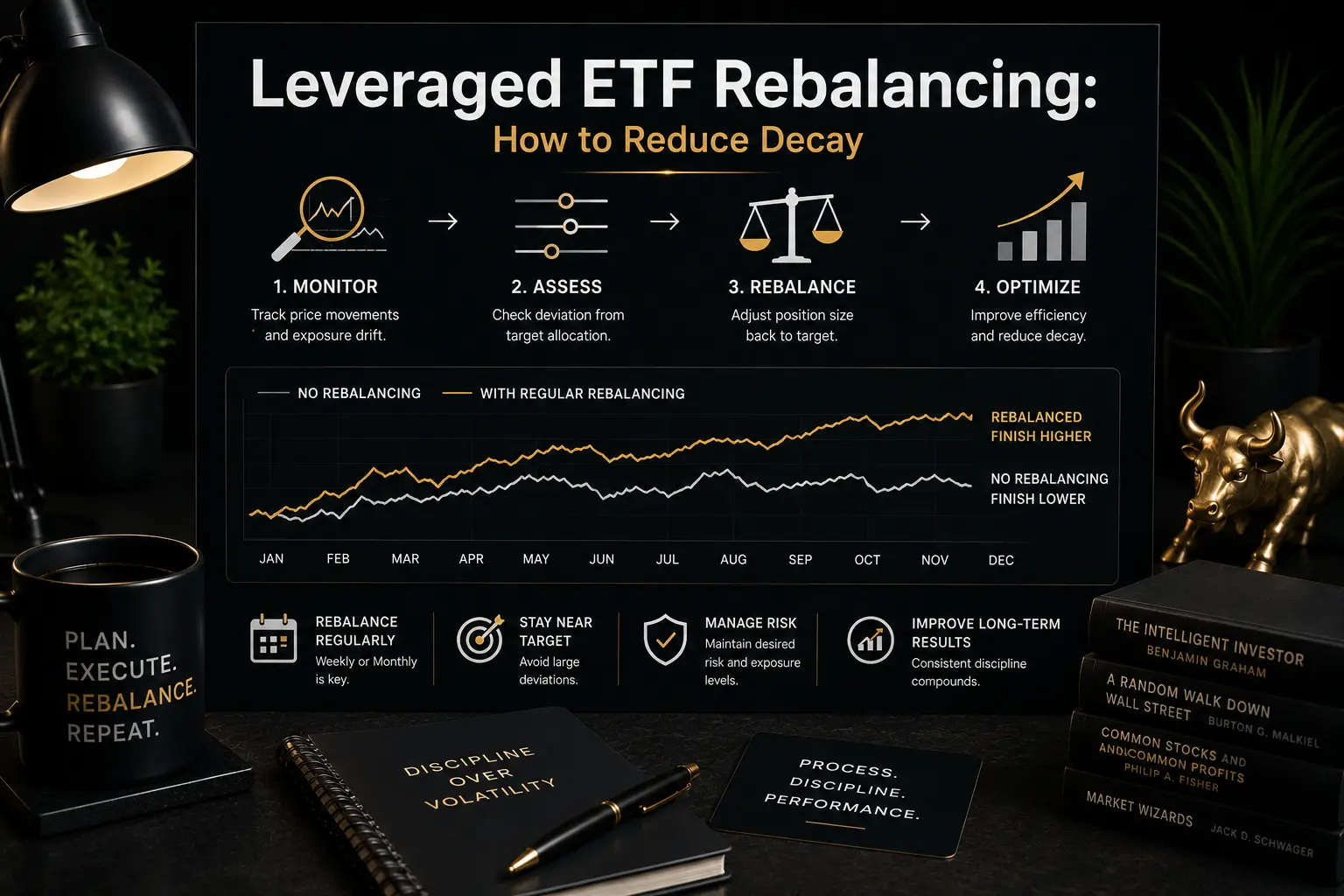
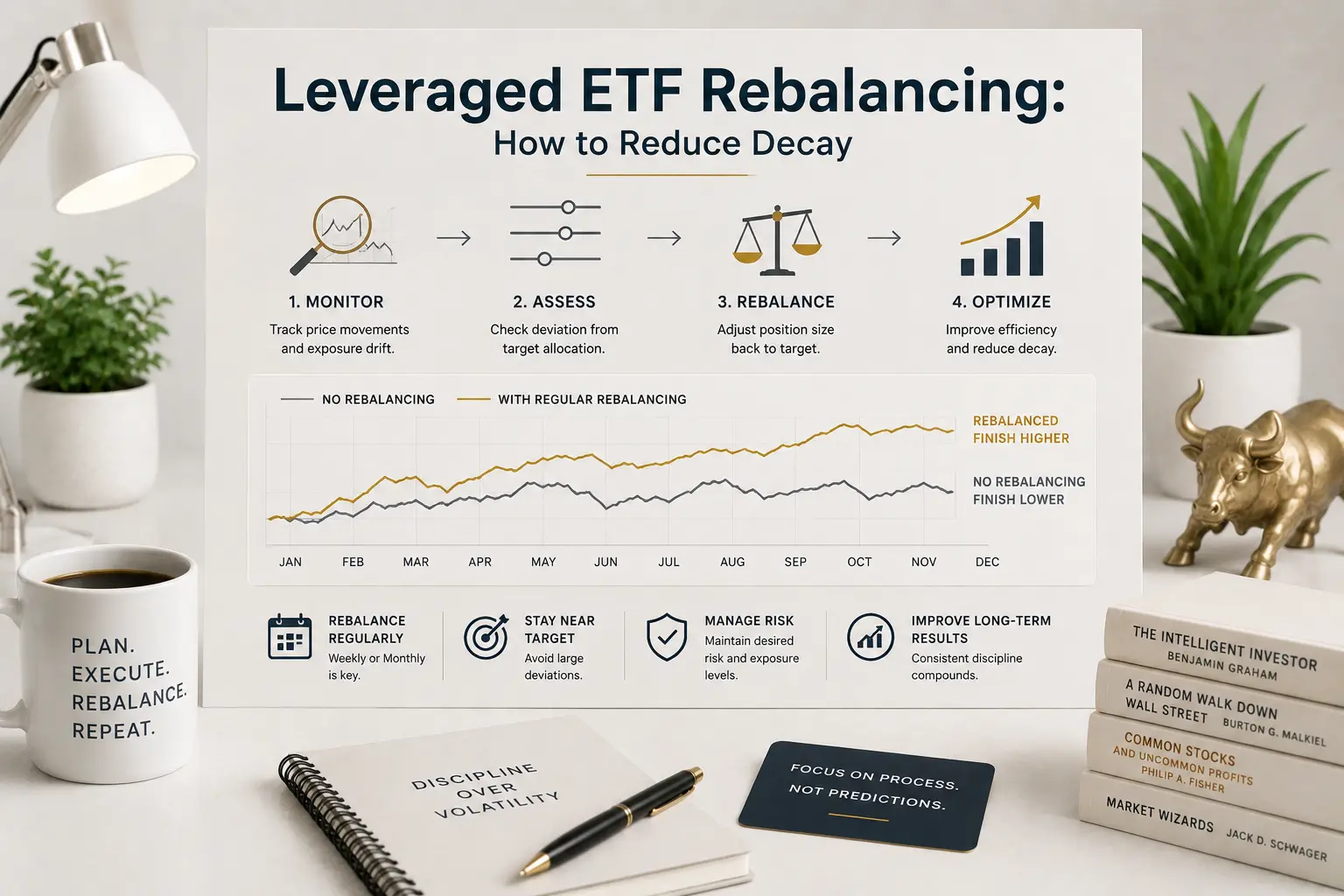
Calendar-based rebalancing - quarterly, monthly - is simple to execute but arbitrary in its timing. A more systematic alternative is threshold-based rebalancing: you only rebalance when the portfolio drifts beyond a defined band from target allocation.
Academic research specifically on leveraged ETF portfolios - Hsieh, Chang, and Chen, “Compounding Effects in Leveraged ETFs: Beyond the Volatility Drag Paradigm,” arXiv:2504.20116, April 2025 - supports a 10% variance threshold as the trigger: rebalance when the portfolio’s allocation drifts more than 10 percentage points from target. The rationale is that small drifts in a leveraged portfolio do not justify the transaction costs and potential tax events of rebalancing, while large drifts meaningfully change the risk profile and can lock in decay if left uncorrected.
In practice, this means setting price alerts or portfolio monitoring rules. If your target is 55% UPRO / 45% TMF and the allocation drifts to 65/35, you rebalance back. If it drifts to 58/42, you leave it.
The advantage over calendar rebalancing: you rebalance when the portfolio actually needs it rather than on an arbitrary schedule. The disadvantage: in fast-moving markets, the allocation can drift through multiple thresholds quickly, requiring frequent intervention at precisely the moment the market is most stressful.
For the TQQQ/TMF variant rather than UPRO/TMF, bi-monthly rebalancing (every two months) has shown stronger historical performance than quarterly in extended backtests, according to research summarized at 7circles.uk. The higher volatility of TQQQ versus UPRO means the allocation drifts faster, making more frequent rebalancing beneficial.
Strategy 3: Calendar Reset ETFs - A Structural Solution to Daily Decay
The strategies above are portfolio-level responses to decay. A more recent development addresses decay at the product level: leveraged ETFs that reset their performance target over a longer period than a single day.
Tradr ETFs launched the first weekly and monthly calendar reset leveraged ETFs in September 2024, followed by quarterly reset ETFs in October 2024. As of December 2025, Tradr manages 54 leveraged ETFs with approximately $2 billion in assets under management, listed primarily on Cboe.
The mechanics differ from standard daily-reset products. A monthly reset ETF targets 2x the performance of its benchmark from the first trading day of the month to the last - not 2x each individual day’s move. This means path dependency and daily compounding drag operate over a month-long window rather than a day-long one. The structural source of decay is reduced, though not eliminated.
The trade-off is meaningful. A daily-reset ETF will reliably deliver approximately 3x the day’s return every single day. A monthly-reset ETF will deliver approximately 2x the month’s return by month-end, but intra-month performance will not track 2x the daily index moves - it can diverge significantly during the month before converging at month-end. For investors with a monthly or quarterly view on a market, this is acceptable. For short-term traders who need precise daily tracking, it is not.
Tradr’s key calendar reset products currently active: MQQQ (2x monthly QQQ), SPYM (2x monthly SPY), SPYQ (2x quarterly SPY), QQQP (2x quarterly QQQ).
Important caveat: Tradr’s original calendar reset ETFs listed on Nasdaq were liquidated in February 2025 as the company migrated products to Cboe. Before implementing a position in any Tradr calendar reset ETF, verify current product availability, liquidity, and bid-ask spreads on Cboe directly. These are newer, smaller products than TQQQ or UPRO, and liquidity matters significantly for any leveraged position.
Strategy 4: Volatility Targeting
The most sophisticated approach - and the most demanding to implement - is volatility targeting: dynamically adjusting your allocation to a leveraged ETF based on the current volatility regime of the underlying index.
The principle: decay is proportional to variance. When volatility is high, decay accelerates. When volatility is low, decay is minimal. Volatility targeting reduces exposure when volatility spikes and increases it when volatility is suppressed.
A practical implementation: use the VIX (for S&P 500-based products) or a 20-day realized volatility measure for the underlying index. Define volatility bands - low, medium, high - and assign target allocations to each.
One version of this framework:
| VIX Level | Allocation to UPRO/TQQQ |
|---|---|
| Below 15 | Full position (e.g. 55%) |
| 15-25 | Reduced position (e.g. 35%) |
| Above 25 | Minimal position (e.g. 15-20%) |
The residual allocation moves to a less volatile asset - short-term Treasuries, money market, or in the HFEA framework, the bond leg.
The empirical support for this approach is strong. Morningstar data from 2009-2018 found that 2x leveraged ETFs averaged an annual return of -11.1% across all ETFs in the category, contrasting sharply with +15.7% returns for underlying indexes over that specific period. That negative average was driven almost entirely by periods of high volatility - investors holding through spike-and-crash cycles. It is worth noting that the post-2018 period through 2026 has been significantly more favorable for leveraged ETFs, particularly those tracking the Nasdaq-100. Volatility targeting specifically targets the reduction of high-volatility exposure that drove the negative historical average.
The practical challenge: this requires active monitoring and discipline to reduce exposure when the market feels most interesting - exactly when most investors want to increase it. Volatility tends to spike during drawdowns, which is also when leveraged ETFs are their cheapest and when the temptation to add more is highest. The discipline to cut when VIX spikes above 25 is the hardest part of the strategy, not the mechanics.
How the Four Strategies Compare
Each strategy addresses a different part of the decay problem. The table below summarizes their characteristics based on historical data and the academic research cited throughout this article.
| Strategy | Mechanism | Historical outcome | Complexity | Key risk |
|---|---|---|---|---|
| HFEA (55% UPRO / 45% TMF) | Uncorrelated hedge + quarterly rebalance | +37% total Oct 2019-Apr 2025 vs S&P 500 +85%; survived 2022 with losses but intact | Low - one rebalance per quarter | Correlation breakdown (2022 proved this) |
| Threshold rebalancing (10% band) | Rebalance only on significant drift | Fewer tax events; similar risk reduction to calendar with less friction | Low - set alerts, check periodically | Requires monitoring; can drift far in fast markets |
| Calendar reset ETFs (Tradr MQQQ/SPYM) | Structural - monthly reset reduces daily path dependency | Reduced decay vs daily-reset; intra-month tracking diverges | Low - buy and hold like any ETF | Thin liquidity; newer products; no 3x option |
| Volatility targeting | Reduce exposure when VIX spikes | Avoids worst drawdown periods; Morningstar data: -11.1% avg for 2x ETFs in 2009-2018 driven by high-vol periods | High - requires active monitoring and pre-defined rules | Behaviorally hardest; reduces upside capture during volatile recoveries |
The key observation: no strategy eliminates decay, and each involves a trade-off between simplicity and precision. HFEA is the easiest to implement consistently. Volatility targeting is theoretically the most effective at protecting capital but the most demanding to execute without emotion. Calendar reset ETFs remove the decision entirely at the product level but sacrifice 3x leverage and accept liquidity risk.
Tax Considerations for International Investors
Leveraged ETFs generate specific tax considerations that differ meaningfully by jurisdiction. Two issues apply broadly across most tax systems.
Rebalancing frequency and capital gains. Every rebalancing event in a taxable account is a potential capital gains event. Quarterly rebalancing of HFEA generates four taxable events per year minimum. In most jurisdictions, capital gains tax on rebalancing proceeds is due before the remaining capital is reinvested - a drag that compounds over time and can meaningfully reduce long-term returns compared to a tax-deferred equivalent.
The cleanest solution: implement leveraged ETF strategies in a tax-deferred or tax-exempt account wherever your jurisdiction allows. Pension wrappers, retirement accounts, and tax-sheltered investment accounts in most countries eliminate the rebalancing tax drag entirely. For taxable accounts, threshold rebalancing - only rebalancing when drift exceeds 10% - reduces the number of annual events compared to calendar rebalancing, which directly reduces the tax leakage.
US estate tax and fund domicile. TQQQ, UPRO, and TMF are all US-domiciled ETFs and are US-situs assets for estate tax purposes. Non-US persons holding these products face potential US estate tax on the full value above a $60,000 threshold - at rates up to 40%. For the leveraged positions these strategies contemplate, where a $100,000 allocation can grow substantially in a bull market, this exposure is material for investors from countries without a US estate tax treaty.
There are no direct Irish UCITS equivalents for 3x leveraged US equity ETFs. The EU’s UCITS regulations cap leverage at 2x for retail-eligible products under ESMA guidelines. Some 2x UCITS leveraged ETFs exist - Xtrackers S&P 500 2x Leveraged Daily Swap UCITS ETF (XS2D) and Amundi Leveraged MSCI USA Daily UCITS ETF (LEVE) among them - but 3x products are not available in UCITS format. Non-US investors using 3x products like TQQQ have no estate-tax-clean alternative. The estate tax exposure is a real, quantifiable cost of accessing 3x leverage that belongs in any position-sizing calculation.
What Rebalancing Does and Does Not Fix
It is worth being direct about the limits of these strategies.
Rebalancing reduces the severity of drawdowns by maintaining a more stable risk profile over time. It forces you to sell the outperformer and buy the underperformer - which is mechanically sound portfolio management and often feels deeply wrong during drawdowns. Done consistently, it has historically improved risk-adjusted returns compared to buy-and-hold in leveraged products.
Rebalancing does not eliminate volatility decay. The daily decay mechanism in the ETF itself continues regardless of how you manage your portfolio allocation. What rebalancing addresses is the portfolio-level risk drift - the gradual increase in equity exposure as leveraged positions grow, which increases loss severity in drawdowns.
Rebalancing also does not protect against the correlation breakdown that destroyed HFEA in 2022. If your hedge - the asset you are rebalancing into - falls alongside your leveraged equity position, the strategy offers no protection. Knowing what conditions break your hedge is as important as knowing how the strategy works when it doesn’t.
The investors who have used leveraged ETF strategies successfully over the past decade share two characteristics. They understood the mechanism well enough to hold through 2022 without panic-selling. And they had a framework - whether HFEA, volatility targeting, or strict position limits - that kept their exposure sized to what they could genuinely tolerate losing, not what they theoretically wished they could hold.
A Practical Framework
Before entering any leveraged ETF position, four questions are worth answering in writing - not in your head, and not after the position is already open.
The first is your rebalancing rule. Calendar rebalancing (monthly or quarterly) is simple and consistent. Threshold rebalancing (only when allocation drifts beyond 10%) is more tax-efficient and avoids arbitrary timing. Either works; what matters is committing to one before the market gives you a reason to abandon it.
The second is your volatility signal, if you are using volatility targeting. Define the VIX thresholds and the corresponding allocation changes in advance. A rule that says “if VIX exceeds 25, I reduce to 20% allocation” is executable. A vague intention to “reduce when things get volatile” is not - because things always feel fine right up until they don’t.
The third, and most important, is your genuine maximum drawdown tolerance. TQQQ lost 79% in 2022. The investor from the opening of this article watched $100,000 become $20,920. If your honest answer to “how much can I lose before I exit?” is 30% or 40%, a 3x leveraged ETF is not sized correctly for your actual risk tolerance - regardless of what the 10-year return data shows. Position size down until the worst historical drawdown is something you could genuinely hold through without selling.
The fourth is account selection. For any rebalancing-intensive strategy, a tax-deferred or tax-sheltered account eliminates the capital gains drag that makes frequent rebalancing progressively less efficient in taxable accounts. If the only account available is taxable, threshold rebalancing reduces the number of events; running a calendar-based strategy in a taxable account without this consideration is leaving a meaningful amount of compounded return on the table.
The Bottom Line
Volatility decay is real, mathematically precise, and manageable - but only if you understand what is actually causing it. It is not a hidden fee or a product defect. It is the cost of daily leverage in a world where markets do not move in straight lines.
The strategies that reduce it - HFEA-style pairing with an uncorrelated hedge, threshold rebalancing, calendar reset products, and volatility targeting - all work by addressing different parts of the same problem. None of them turns a 3x leveraged ETF into a smooth compounder. All of them improve the odds of staying in the position through the volatile periods that decay extracts the most from.
TQQQ’s 10-year CAGR of 44% is real. So is the -79% it delivered in 2022. The investors who captured the long-term return are the ones who had a framework going in - not just a conviction about the direction of the Nasdaq.
This article is for informational purposes only and does not constitute investment advice. Leveraged ETFs are complex instruments and carry significant risk of capital loss. All figures and market data reflect publicly available information as of May 2026. Past performance is not a guarantee of future results. Consult a qualified financial adviser before making investment decisions.