

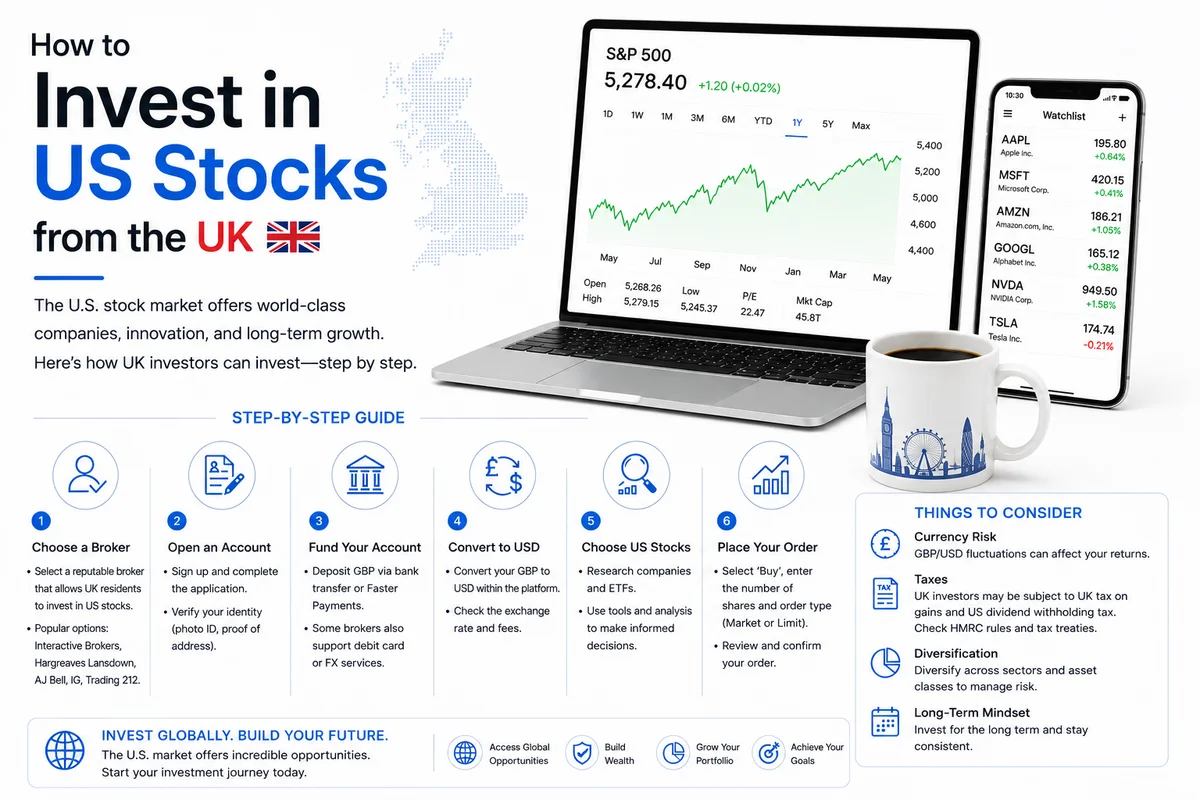
Updated: May 2026 - GetGlobalYields.com - Read time: ~12 min
UK investors have some of the best tools in the world for owning US stocks tax-efficiently. The ISA and SIPP wrappers, combined with the US-UK tax treaty, create a structure that most other countries genuinely envy. But there is a common misunderstanding that costs UK investors real money every year - and almost no guide explains it clearly.
The misunderstanding: your ISA does not protect you from US withholding tax on US dividends.
ISAs shield you from UK income tax and UK capital gains tax. They do not override the IRS. When a US company pays a dividend into your ISA, the US still withholds 15% before it arrives. Your ISA wrapper cannot claim that back. The money is simply gone.
Understanding this distinction - and knowing that a SIPP actually does get you to 0% withholding on US dividends - changes how you think about where to hold different assets. This guide covers that, plus everything else you need to invest in US stocks from the UK efficiently and correctly in 2026.
Bottom Line: UK investors can buy US stocks directly through any FCA-regulated broker or through IBKR. The US-UK tax treaty reduces dividend withholding to 15% (or 0% in a SIPP). CGT rates in a GIA are 18% or 24% depending on your income tax band, with a £3,000 annual exemption. An ISA eliminates UK tax but not US withholding. The account type you choose matters more than the broker you choose.
Is It Legal and Easy?
Yes on both counts. There are no restrictions on UK residents buying US-listed stocks and ETFs. You do not need special permissions, a US bank account, or anything beyond a standard brokerage account with a broker that offers US market access - which most UK brokers do.
The process is simpler than most non-US countries because the UK has a mature, well-regulated financial services industry, most UK brokers already handle W-8BEN as standard, and the US-UK tax treaty is one of the most comprehensive bilateral tax agreements in existence.
The Three Account Types - and Why It Matters More Than You Think
Before choosing a broker, decide where you are going to hold your US stocks. The account type determines your tax treatment, and the differences are significant.
Stocks and Shares ISA
The ISA is the default account for most UK retail investors - and for good reason. Gains are completely free from UK CGT. Dividends are free from UK income tax. The annual allowance is £20,000 for 2026/27.
For UK stocks, an ISA is as good as it gets. For US stocks, there is one caveat that matters: the US withholds 15% on dividends before the money enters your ISA. This withholding cannot be reclaimed. If you are building a dividend-focused US portfolio inside an ISA, you are permanently losing 15% of every dividend to US withholding - and you receive no UK tax relief on it because the ISA already gives you zero UK tax.
For growth-focused US positions where dividends are minimal - think QQQ, individual tech stocks, or accumulating ETFs - an ISA is excellent. For high-dividend US positions like SCHD or JEPI, the 15% withholding drag is a real cost to factor in.
SIPP (Self-Invested Personal Pension)
This is where it gets genuinely interesting for US stock investors.
The IRS recognises UK SIPPs as qualifying pension schemes. This means US companies pay dividends into your SIPP with zero withholding - not 15%, not 25%, zero. No W-8BEN required; your broker or SIPP provider handles the pension recognition automatically.
For income-focused US investors, holding dividend-paying US stocks or ETFs in a SIPP rather than an ISA eliminates the 15% withholding entirely. The trade-off is that SIPP funds cannot be accessed until age 57 (rising to 58 in 2028), and withdrawals in retirement are taxed as income (with 25% available tax-free).
If you are a long-term investor and dividend income is part of your strategy, the SIPP treatment of US dividends is one of the most underused advantages available to UK investors.
General Investment Account (GIA)
The GIA has no annual contribution limits and no access restrictions - but gains and dividends are taxed in full.
Dividends from US stocks in a GIA are subject to US withholding at 15% (with W-8BEN filed) and then reportable as dividend income in the UK. After the £500 dividend allowance, UK dividend tax rates apply: 8.75% (basic rate), 33.75% (higher rate), or 39.35% (additional rate).
Capital gains in a GIA are subject to UK CGT. The annual CGT exemption is £3,000 for 2026/27. Above that, gains are taxed at 18% for basic rate taxpayers or 24% for higher and additional rate taxpayers. There is no separate lower rate for US stocks versus UK stocks - the rates are the same.
One practical GIA strategy: use your £3,000 annual CGT exemption actively. Realising gains up to the exemption each year, then buying back into the same position, resets your cost base without triggering tax. It takes discipline but is entirely legitimate.
Account summary
| Account | UK CGT | UK income tax on dividends | US withholding | Annual limit |
|---|---|---|---|---|
| ISA | 0% | 0% | 15% (irrecoverable) | £20,000 |
| SIPP | 0% (in fund) | 0% (in fund) | 0% | Annual pension allowance |
| GIA | 18-24% above £3k | 8.75-39.35% above £500 | 15% (partial credit) | None |
W-8BEN: File It, Keep It Active
The W-8BEN is the IRS form that confirms you are a UK tax resident and claims the reduced treaty rate on dividends. Without it, US withholding defaults to 30%. With it, the rate drops to 15%.
Most UK brokers collect this during account setup or as part of their onboarding for US markets. It expires every three years - your broker should send a renewal reminder, but do not wait for one. If it lapses, your withholding reverts to 30% until you renew.
One important note: in a SIPP, you do not file an individual W-8BEN. The pension trustee or SIPP provider handles the pension recognition separately with the IRS, which is what secures the 0% withholding rate. This happens automatically - you do not need to do anything extra.
UCITS ETFs vs US-Listed ETFs: A Decision Worth Making
UK investors have a choice that many other nationalities do not: Ireland-domiciled UCITS ETFs that track US indices.
Most mainstream index ETFs available in the UK are domiciled in Ireland - iShares Core, Vanguard UCITS, Invesco, Xtrackers. Ireland has its own tax treaty with the US that caps dividend withholding at the fund level to 15%. This is the same rate you get as an individual investor via W-8BEN, so for the ISA context, the outcome is similar.
Where UCITS ETFs have a specific advantage: accumulating share classes. An accumulating UCITS ETF automatically reinvests dividends inside the fund rather than distributing them to you. Since the dividend is never paid out to you, there is no UK income tax event in a GIA. The value accrues as capital gain instead, which you control the timing of. For GIA investors in higher tax brackets, this is a meaningful structural advantage - dividend tax rates in the UK are higher than CGT rates.
The trade-off: US-listed ETFs like QQQ or SPY typically have lower expense ratios than their UCITS equivalents, and the product range is far wider. If you are investing inside an ISA or SIPP where the tax wrapper already handles most of the tax question, US-listed ETFs are often worth the slightly higher withholding complexity for the wider selection and lower fees.
Which Broker Should UK Investors Use?
The UK broker landscape is genuinely competitive. The right choice depends on what you are trying to do.
Interactive Brokers (IBKR)
The best option for serious investors who want the full range of US markets, the lowest FX costs, and professional tools. IBKR offers stocks, ETFs, options, bonds, and futures with near-interbank FX rates at 0.002% - which matters every time you convert GBP to USD.
IBKR offers an ISA in the UK with a £3 monthly fee (waived if you pay at least £3 in commissions that month). For active investors making at least one trade a month, the fee effectively disappears. For passive investors making one trade per quarter, the fee structure means IBKR’s ISA is more expensive than commission-free alternatives like Trading 212.
For options trading, bonds, and anything beyond basic stocks and ETFs, IBKR has no serious competition in the UK market.
Trading 212
Commission-free stocks and ETFs, a clean mobile interface, ISA and SIPP available, and an interesting detail: Trading 212 uses IBKR as its custodian. Your assets are ultimately held through IBKR’s infrastructure even when you use the Trading 212 interface.
Trading 212 is excellent for investors who want simplicity, zero commissions, and do not need options or advanced order types. The FX fee on US stocks is 0.35% - higher than IBKR but reasonable for occasional investors. The platform also pays competitive interest on uninvested cash.
Freetrade
Similar positioning to Trading 212 - commission-free, mobile-first, ISA available. The product range is narrower (no options, bonds, or futures) and the platform is more limited for research. Good for beginners building a straightforward long-term portfolio.
Hargreaves Lansdown
The largest UK investment platform by assets. Excellent research tools, strong customer service, and a well-regarded SIPP. The fees are higher than IBKR or Trading 212 - dealing charges for shares are £11.95 per trade dropping to £5.95 for frequent traders. For large, infrequent trades the per-trade fee is manageable. For frequent smaller trades it adds up. The SIPP offering is particularly well-regarded for retirement-focused investors.
Honest comparison:
| Broker | Best for | FX fee on US stocks | ISA available | Options |
|---|---|---|---|---|
| IBKR | Serious investors, options, full access | 0.002% | Yes (£3/month fee) | Yes |
| Trading 212 | Beginners, commission-free | 0.35% | Yes | No |
| Freetrade | Beginners, mobile-first | 0.45% | Yes | No |
| Hargreaves Lansdown | Research, SIPP quality | 1% (cap £5.99) | Yes | Limited |
The Real Costs Nobody Highlights
FX conversion is where most platforms make their money. When you buy a US stock priced in dollars using a GBP account, your platform converts at their rate. At Trading 212 that is 0.35%. At Hargreaves Lansdown it is 1% capped at £5.99. At IBKR it is 0.002%. On a £10,000 investment, the difference between IBKR and Hargreaves Lansdown is roughly £100 - before you have made a single penny in returns.
US estate tax is real and applies to UK investors. Non-US residents holding US-domiciled assets - stocks and ETFs listed on NYSE or NASDAQ - are subject to US estate tax on holdings above approximately $60,000, at rates up to 40%. The US citizen exemption is over $13 million. The non-resident exemption is $60,000. This is one of the most consistently overlooked risks among UK investors building large US equity positions. Ireland-domiciled UCITS ETFs are not subject to this because they are not US-domiciled assets. For investors building substantial long-term positions, this is worth discussing with a tax advisor.
The ISA withholding trap. As covered above - 15% US withholding on dividends inside an ISA is irrecoverable. For high-yield US positions, this is a real ongoing drag. Consider whether those positions belong in your SIPP instead.
Tax: The Full Picture for UK Investors in 2026
Dividends
In an ISA: US withholds 15% (with W-8BEN). No UK tax. The 15% is gone permanently.
In a SIPP: 0% US withholding. No UK tax while in the fund. Tax applies on withdrawal in retirement (25% tax-free, remainder taxed as income).
In a GIA: US withholds 15% (with W-8BEN). In the UK, declare the gross dividend as income. After the £500 dividend allowance, pay UK dividend tax at your applicable rate. You can claim partial credit for the US withholding against your UK tax liability - meaning you pay the higher of the two rates rather than both in full, but the mechanics require you to file a Self Assessment and claim the foreign tax credit explicitly.
Capital Gains
The US does not tax capital gains for non-US residents. Zero. When you sell a US stock at a profit, the proceeds arrive in full without any US deduction.
In the UK, gains above the £3,000 annual exemption are taxed at 18% (basic rate taxpayers) or 24% (higher and additional rate taxpayers). These rates apply equally to US and UK stocks. Note that currency movements on USD positions can create taxable gains even if the share price is unchanged - if GBP/USD moves between your purchase and sale, the GBP value of your position changes, and HMRC treats the currency gain as part of your capital gain.
Self Assessment
If you hold US stocks in a GIA, you will likely need to file a Self Assessment return to declare foreign dividend income and claim foreign tax credits. If all your US holdings are inside an ISA or SIPP, you have nothing to declare to HMRC in relation to those investments.
What Most Guides Do Not Tell You
Your SIPP is more powerful than your ISA for US dividends. The 0% withholding rate in a SIPP versus 15% in an ISA is a genuine, permanent difference that compounds over decades. If you are building income-generating US positions for the long term, the SIPP deserves more consideration than it typically gets.
Currency gains are taxable in a GIA. Most investors track their returns in GBP and assume they are only paying tax on the stock’s performance. If you bought QQQ when GBP/USD was 1.35 and sold when it was 1.20, you made a currency gain in addition to any stock gain - and HMRC treats this as part of your CGT calculation. Keep records of the exchange rate at every purchase and sale.
The £3,000 CGT exemption is worth using actively. With gains under £3,000 untaxed, realising profits up to the exemption each year and reinvesting is entirely legitimate. Many GIA investors let gains accumulate for years and then face a large tax bill. Annual housekeeping is better.
Accumulating UCITS ETFs in a GIA defer dividend tax. If you hold an accumulating share class of a UCITS ETF - where dividends reinvest inside the fund rather than being paid out - you avoid UK dividend tax events in a GIA. The value accrues as capital gain instead. Given that UK dividend tax rates (33.75% for higher rate) are higher than CGT rates (24%), this is a meaningful structural difference for investors in a GIA.
Frequently Asked Questions
Can UK investors buy US stocks directly? Yes. Any FCA-regulated broker with US market access allows you to buy US-listed stocks and ETFs directly. Most mainstream UK platforms offer this as standard.
Do I pay CGT on US stocks in the UK? Yes, on gains above the £3,000 annual exemption - at 18% (basic rate) or 24% (higher and additional rate). An ISA or SIPP eliminates UK CGT on investments held within the wrapper.
Does my ISA protect me from US withholding tax? No. The ISA shields you from UK income and capital gains tax, but the US still withholds 15% on dividends before they enter your ISA. This 15% is irrecoverable inside an ISA.
How does a SIPP get 0% withholding on US dividends? The IRS recognises UK SIPPs as qualifying pension schemes. Your SIPP provider handles the recognition automatically. No individual W-8BEN is required.
What is the W-8BEN and do I need one? The W-8BEN confirms you are a UK tax resident and claims the 15% treaty rate on US dividends instead of the default 30%. Most UK brokers collect it during account setup for US markets. It must be renewed every three years.
What happens if I do not file W-8BEN? The US defaults to 30% withholding on dividends instead of 15%. The difference is significant on any meaningful dividend income.
Are UCITS ETFs better than US ETFs for UK investors? It depends on the account and the strategy. In an ISA, both face 15% withholding at some level, but accumulating UCITS ETFs eliminate dividend distributions entirely. In a GIA, accumulating UCITS ETFs defer dividend tax. In a SIPP, US-listed ETFs benefit from 0% withholding. The right answer varies by account type and tax situation.
What is the US estate tax risk for UK investors? Non-US residents holding US-domiciled assets above approximately $60,000 are subject to US estate tax at rates up to 40%. Ireland-domiciled UCITS ETFs are not subject to this. For investors building large US equity positions, this is worth specific planning.
What to Do This Week
1. Decide where your US holdings belong. If you have both an ISA and SIPP available, think about which US positions generate meaningful dividends. High-yield positions belong in the SIPP where withholding is zero. Growth positions with minimal dividends are fine in the ISA.
2. Check your W-8BEN status. Log into your broker and confirm your W-8BEN is filed and current. If you have not filed one, do it now - every dividend paid before it is active is being withheld at 30% instead of 15%.
3. Open your ISA allowance for the year. The £20,000 ISA limit resets each April. If you have not used this year’s allowance, contribute before the next tax year ends. From April 2027 the cash ISA limit changes - this year is the last at full £20,000 flexibility.
4. Compare your broker’s FX rate against IBKR. If you are making regular GBP-to-USD conversions, calculate what the FX markup is costing you annually. For investors making more than £5,000 in US purchases per year, the IBKR FX rate difference versus high-street platforms is a real, compounding cost.
Final Thoughts
UK investors are genuinely well-positioned to own US stocks. The ISA and SIPP wrappers eliminate UK tax on investments held within them, the US-UK treaty cuts withholding to 15% in an ISA and 0% in a SIPP, and the broker options are competitive and well-regulated.
The main things to get right: file your W-8BEN, think carefully about which account type suits each type of US position, use your annual ISA and CGT allowances actively, and understand the US estate tax risk before you build a large position.
For most UK investors, a combination of ISA for growth-focused US positions and SIPP for income-focused ones - with IBKR for serious long-term investing or Trading 212 for simpler needs - covers the full picture efficiently.
Related Articles
- Interactive Brokers Review 2026: The Best Broker for International Investors
- W-8BEN Form: Complete Guide for Non-US Investors
- Saxo Bank Review 2026: Pro Features for High Net Worth Investors
- TQQQ Tax Implications for International Investors
⚠️ Financial Disclaimer: This guide is for informational purposes only and does not constitute financial or tax advice. UK tax rules, ISA limits, CGT rates, and SIPP regulations are subject to change. Always consult a qualified financial adviser or tax professional for advice specific to your situation. Information is current as of May 2026.