
Who This Article Is For
David, an Israeli investor with $80,000 in TQQQ, found the 225-day SMA strategy in early 2022 - right after QQQ crossed below the line in January. He moved to cash. He avoided the 79% drawdown. He re-entered in late November 2022 when QQQ crossed back above. He captured the full 198% 2023 rally. On paper, the strategy worked exactly as advertised.
What David does not know yet is that Masonson’s own research shows the strategy delivers lower risk-adjusted returns on TQQQ than simply buying and holding it. Not because 2022 was wrong. Because the compounding David missed in 2020, and will miss again in the next fast recovery, costs more over a decade than the drawdowns the strategy avoids.
If you hold TQQQ and have encountered this strategy - or are considering it - this article presents what it actually delivers, verified, for both QQQ and TQQQ, and what you should do with it instead.
The Strategy: What It Is and Where It Comes From
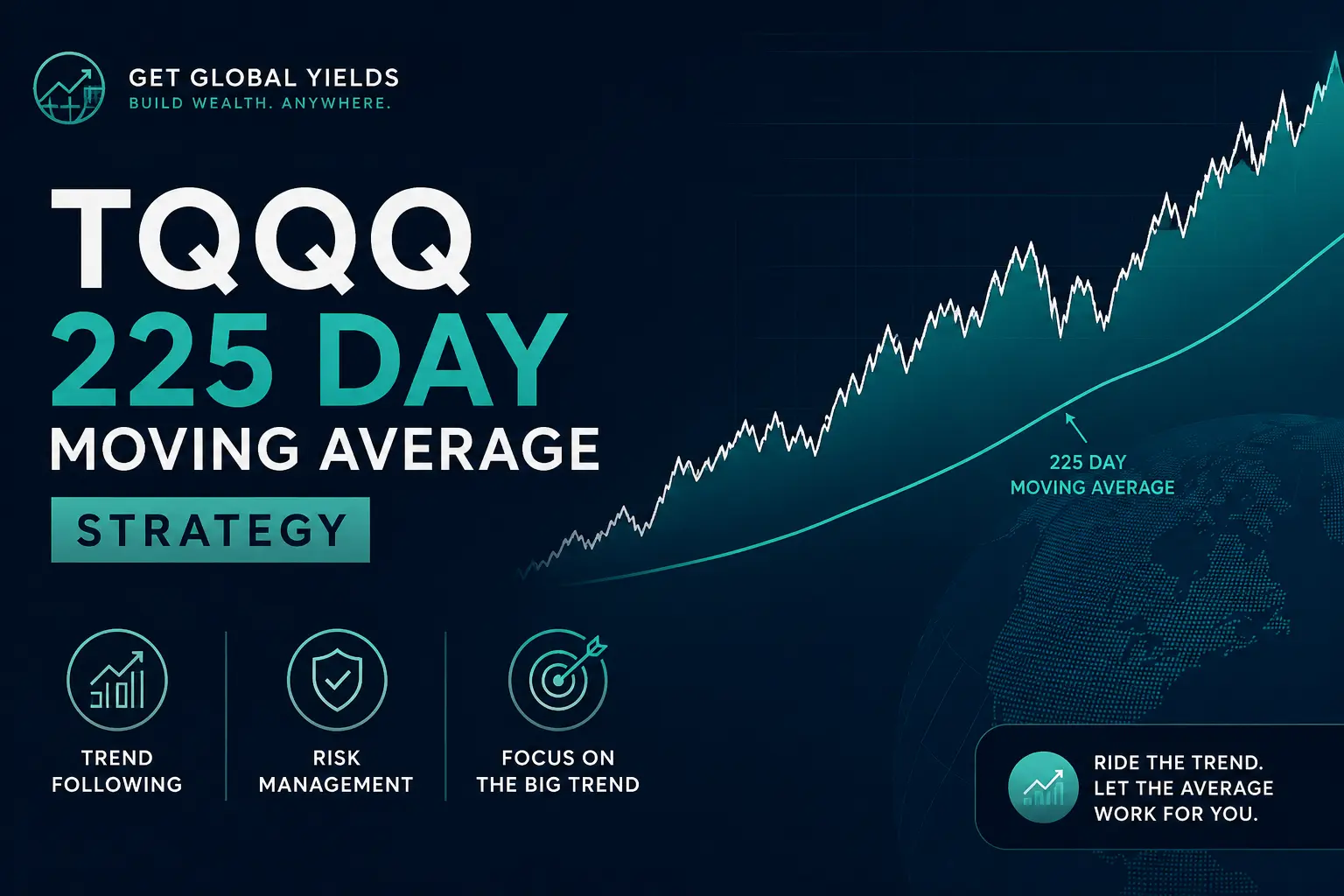
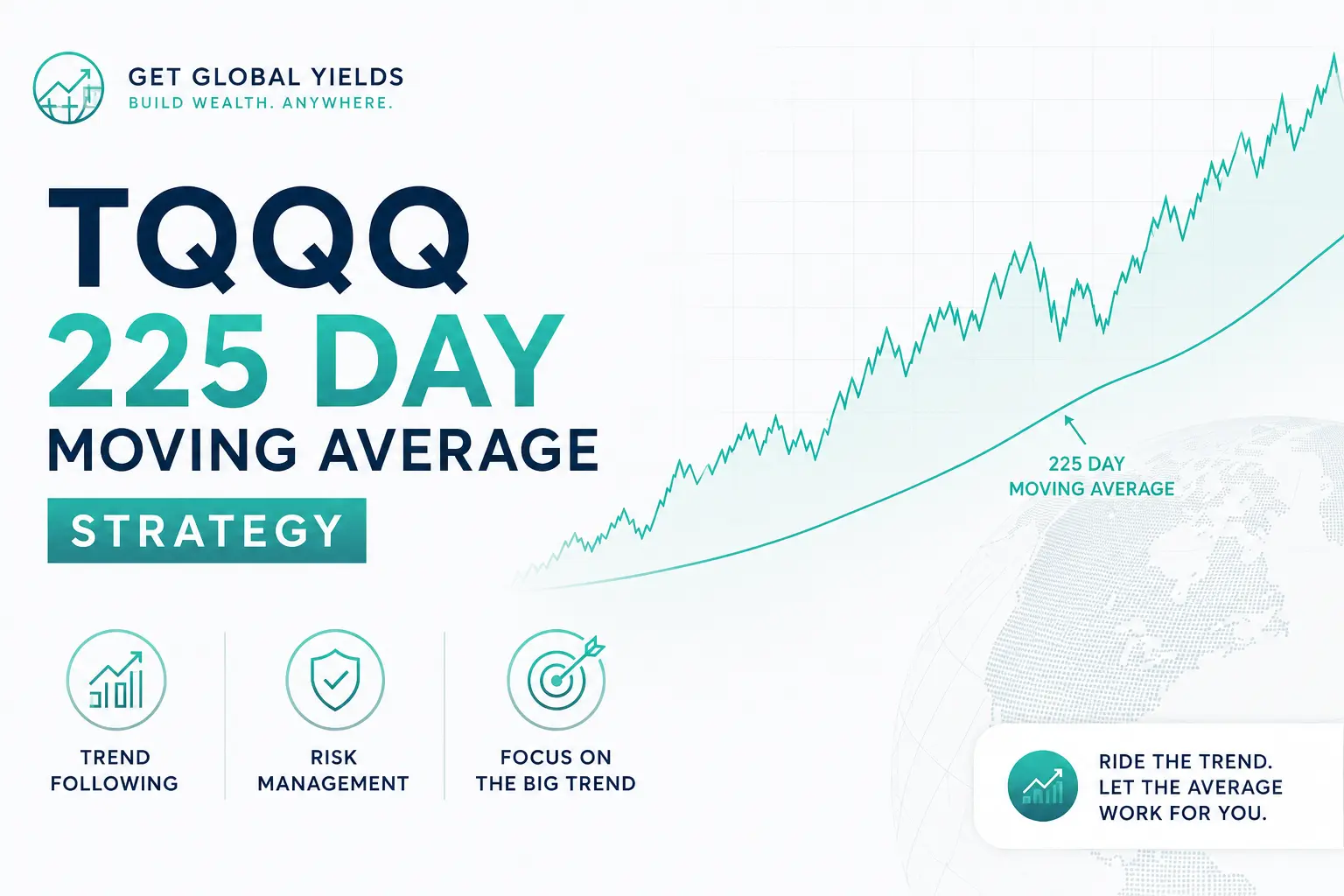
The 225-day simple moving average strategy was documented in detail by Leslie Masonson in his book The Triple Qs and the T-Triple Qs ETF Profit Machine (2025). Masonson has over 50 years of market experience, has authored six financial books, and has actively traded Nasdaq-100 instruments for 15+ years.
The rules are entirely mechanical:
- Buy signal: When QQQ’s daily closing price crosses above its 225-day simple moving average, buy QQQ (or the instrument of choice).
- Sell signal: When QQQ’s daily closing price crosses below its 225-day simple moving average, sell and move entirely to cash.
- No partial positions, no hedging, no additional filters in the base version.
The logic is momentum-based: the 225-day SMA represents approximately 45 calendar weeks of price history, long enough to filter out short-term noise while capturing the major bull and bear market transitions. When QQQ is consistently above this level, the broad trend is up. When it breaks below, the trend has deteriorated sufficiently that the expected value of staying in is negative.
The Verified QQQ Backtest: What Masonson Found
For QQQ, the strategy’s 25-year backtest (January 2000 through February 2025) produces results that are both verified and significant.
QQQ 225-day SMA strategy vs. buy-and-hold (Jan 2000 - Feb 2025):
| Metric | 225-Day SMA Strategy | Buy-and-Hold QQQ |
|---|---|---|
| Total return | 1,061% | 628% |
| Maximum drawdown | -28.6% | -83.0% |
| Period | 25 years | 25 years |
Source: Leslie Masonson, The Triple Qs and the T-Triple Qs ETF Profit Machine (2025); independent review at FinancialWisdomTV.com (January 2026).
The strategy delivered approximately 68% more total return while cutting the maximum drawdown from 83% to 28.6% - a reduction of more than two-thirds. For context, the 83% buy-and-hold drawdown reflects what QQQ investors experienced during the 2000-2002 dot-com collapse, when the Nasdaq-100 fell from its March 2000 peak to a trough in October 2002 and did not recover to that peak price until 2016.
The strategy avoided the worst of that decline because QQQ broke below its 225-day SMA in April 2000 - early enough to sidestep most of the subsequent 83% fall. Similarly, the strategy moved to cash in January 2022 as QQQ broke its 225-day SMA, avoiding much of that year’s 33% decline.
Why 225 days specifically, rather than the more commonly used 200?
The 200-day SMA is the most widely watched moving average in financial markets. Precisely because of this, institutional algorithms create predictable behavior around it - hunting stop-losses positioned just below the 200-day line, creating false breakdowns that immediately reverse. The 225-day line sits above the institutional noise zone while remaining responsive enough to capture genuine trend changes. In Masonson’s backtesting, the 225-day produced cleaner signals than the 200-day across the full 25-year period.
The TQQQ Problem: Why the Same Strategy Underperforms
Here is the verified finding that most articles about this strategy do not state clearly: when the same 225-day SMA strategy is applied to TQQQ rather than QQQ, the risk-adjusted performance is lower than simply buying and holding TQQQ.
Masonson’s own research states this directly: for TQQQ, the strategy reduced maximum loss modestly but delivered lower risk-adjusted returns compared to buy-and-hold over the same period.
This is not a minor footnote. It is a structural result - and the scale of what the strategy sacrifices matters. TQQQ’s since-inception CAGR is 43.50% annualized (MyPlanIQ, February 2010 - May 6, 2026) with a cumulative total return of 34,625% over the same period. As of May 26, 2026 - incorporating the strong YTD recovery - TotalRealReturns.com calculates the since-inception nominal return at 39,526% at 44.38% annualized. The difference between these figures reflects the calculation date: TQQQ returned +55% YTD through late May 2026, moving the cumulative figure substantially. Both numbers are correct for their respective calculation dates.
These extraordinary figures exist because of compounding during extended bull markets. Any strategy that moves TQQQ investors to cash during the early stages of those bull runs gives up a portion of the compounding that drives these numbers - and at 3x leverage, even a few missed months is expensive.
Understanding why this happens structurally is the most useful thing this article can offer.
Reason 1: TQQQ’s amplified gains during bull markets are the primary driver of its total return
TQQQ’s extraordinary compounding exists almost entirely because of returns during extended bull markets: 2019 (+134%), 2020 (+110%), 2021 (+83%), 2023 (+198%), 2024 (+58%). These gains compound on a growing base during continuous uptrends.
The 225-day SMA strategy’s defining characteristic is that it moves to cash during uncertain periods - including the early stages of a new bull run, before the price has convincingly re-established itself above the 225-day line. For QQQ, missing the first few months of a bull market recovery costs a few percentage points. For TQQQ at 3x leverage, missing the same months costs 3x that in raw return terms - often the equivalent of months of compounding that cannot be recovered.
In the 2020 COVID crash recovery, QQQ broke back above its 225-day SMA in approximately late May 2020. By that point, TQQQ had already risen approximately 150% from its March 2020 bottom. An investor who moved to cash in March and re-entered in May captured only the later part of that extraordinary run.
Reason 2: The strategy generates short-term capital gains in a taxable account
Every exit from TQQQ to cash is a taxable event. Because most TQQQ exit signals occur after holding periods of less than one year - the strategy is designed to be in cash during bear markets that typically last 6-18 months - the gains crystallized are short-term capital gains, taxed at ordinary income rates.
For a US investor in the 32% federal bracket, a strategy that generates 20% of pre-tax gains annually but crystallizes them as short-term gains retains approximately 13.6% after tax. Buy-and-hold TQQQ, with the same 20% pre-tax return, retains approximately 16% after tax (20% long-term capital gains rate after one year). The tax cost of active trading erodes a significant portion of the strategy’s theoretical pre-tax advantage.
For non-US investors, each QQQ crossing below the 225-day line that triggers a TQQQ sale crystallizes a gain taxed at the full domestic rate - 25% in Germany (Abgeltungsteuer), 18-24% in the UK, 25% in Israel. Multiple whipsaw signals in a sideways year each trigger a separate taxable event.
Reason 3: Whipsaw trades in volatile markets
The 225-day SMA strategy generates false signals when the market oscillates around the moving average without establishing a clear trend. These whipsaw trades are more frequent than most investors assume. StockCharts analyst Arthur Hill documented (May 2025) that SPY crossed its 200-day SMA 141 times between 2005 and 2025 - averaging approximately 7 crossovers per year - with 22 crossovers between January 2022 and March 2023 alone. QQQ behaves similarly. The 225-day SMA, being slower, produces fewer crossovers than the 200-day - but the same dynamic applies in choppy, directionless markets.
For QQQ, a whipsaw trade costs approximately the transaction cost plus a few percentage points of missed movement. For TQQQ, the same whipsaw at 3x leverage means selling after a -15% move and buying back after the price has already recovered - a round-trip loss of 30%+ in a matter of weeks.
Independent analysis of the 200-day SMA strategy applied to QQQ3 (the UCITS equivalent of TQQQ) has noted that this whipsaw problem was particularly visible in 2016 - a year where QQQ oscillated around its 200-day line multiple times without establishing a sustained trend, generating several false exit signals that each cost meaningful capital in the leveraged version.
The buffer approach - requiring QQQ to close a defined percentage above the 225-day SMA before entering (e.g., +5%) and a defined percentage below before exiting (e.g., -3%) - reduces whipsaw frequency significantly. But it introduces its own cost: you enter later in every bull run and exit later in every bear market, which affects the total return profile.
The 2022 Stress Test
2022 is the most useful case study for evaluating this strategy in practice.
QQQ broke below its 225-day SMA in January 2022 and did not recross above it until late November 2022. A strict application of the strategy would have moved investors to cash in January 2022 and kept them there for approximately 10 months.
For QQQ: the buy-and-hold investor lost approximately 33% in 2022. The strategy investor in cash preserved capital during that period.
For TQQQ: the buy-and-hold investor lost approximately 79% in 2022. The strategy investor moved to cash in January, preserving nearly everything.
This is where the strategy genuinely shines for leveraged investors. The downside protection in sustained bear markets is real and substantial. The -79% TQQQ drawdown without the strategy vs. a near-zero loss in cash is a dramatic difference.
The complication is what happened next. QQQ’s first convincing recross above the 225-day SMA came in late November 2022. But TQQQ had already risen approximately 80% from its December 2022 bottom by the time the signal confirmed. An investor re-entering TQQQ on the 225-day crossover in late November captured the 2023 rally from that level - still extraordinary at +198% - but missed the initial recovery bounce.
This is the fundamental tension: the strategy reliably prevents catastrophic losses in genuine bear markets, but consistently enters the recovery later than buy-and-hold. For QQQ, entering later costs a modest amount. For TQQQ at 3x, the timing gap costs proportionally more.
The Practical Framework: How to Use the 225-Day SMA With TQQQ
Given the verified finding that the pure 225-day SMA strategy underperforms buy-and-hold TQQQ on a risk-adjusted basis, the question becomes: what is the right way to use this tool with leveraged ETFs?
Option 1: Apply the strategy to QQQ, not TQQQ
This is the strategy Masonson actually backtested. Use the 225-day SMA to time allocation to QQQ - not TQQQ. The risk-adjusted returns are demonstrably superior to buy-and-hold QQQ over 25 years, with a maximum drawdown reduced from 83% to 28.6%.
For investors who want leveraged exposure, this approach uses TQQQ only during confirmed bull markets (QQQ above its 225-day SMA) and switches to cash or SGOV during downtrends. SGOV’s 30-day SEC yield as of May 28, 2026 is 3.53% (iShares, verified). The distinction from applying the strategy to TQQQ directly is subtle but important: you are using QQQ’s price behavior as the signal, which is cleaner, and you are using cash as the default rather than holding TQQQ through potentially months of bearish oscillation.
Option 2: Add a percentage buffer to reduce whipsaws
Rather than acting on every 225-day SMA crossover, require confirmation: buy TQQQ only when QQQ closes 3-5% above the 225-day SMA; sell only when QQQ closes 3% below it. Park proceeds in SGOV (3.53% 30-day SEC yield as of May 28, 2026) between trades.
The buffer reduces false signals at the cost of slightly later entries and exits. For TQQQ specifically, where each whipsaw trade costs 3x what it would cost in QQQ, this trade-off is usually favorable.
As of late May 2026, QQQ is trading at approximately $729 (52-week high: $733, verified via Yahoo Finance and FinanceCharts, May 27, 2026), well above its 200-day SMA of approximately $614. The 225-day SMA sits slightly higher, at approximately $614-$620. The strategy is in a fully invested posture under any buffer variant.
Option 3: Use the 225-day SMA as one signal among several, not a standalone rule
Masonson himself advocates a composite indicator approach in the more advanced sections of his framework: take action on the 225-day SMA crossover only when confirmed by at least two additional indicators - MACD crossover, RSI reading, or percentage of Nasdaq-100 stocks above their 50-day moving averages. The multi-indicator approach dramatically reduces false signals in sideways markets.
The practical cost is complexity: you need to monitor multiple indicators simultaneously, define the precise rules for each, and execute consistently when signals align. For investors who want mechanical simplicity, Option 1 or 2 is more reliable in practice than a multi-indicator approach that requires judgment calls.
What to Do Today - Three Concrete Steps
Step 1: Open TradingView or Yahoo Finance. Search QQQ. Add the 225-day simple moving average to the chart. Note the current SMA level and where QQQ’s closing price sits relative to it. This takes three minutes and gives you the live signal the strategy runs on.
Step 2: Decide which option fits your situation - the pure strategy on QQQ (Option 1), the buffer approach (Option 2), or the composite signal (Option 3) - before QQQ approaches the SMA again. The time to make that decision is now, not when QQQ is -8% and the SMA is a few points away.
Step 3: Write down the rule and the tax cost. If you are in a taxable account, calculate what a TQQQ sale at current prices would cost in CGT before you commit to the strategy. If the tax cost of one exit exceeds 18 months of SGOV income on that capital, factor that into whether the strategy makes sense for your specific situation.
For David: his $80,000 TQQQ position at current prices would generate a significant taxable gain if he exits on the next SMA signal. The right answer for him is not “always exit” or “never exit” - it is knowing the exact tax cost in advance and having the rule written before the signal fires.
Tax Considerations for Non-US Investors
The tax mechanics of this strategy deserve specific attention for international investors.
For non-US investors in a taxable account: Each QQQ exit signal that triggers a TQQQ sale crystallizes a taxable event. Capital gains tax rates vary by jurisdiction - 25% in Germany (Abgeltungsteuer), 18-24% in the UK, 25% in Israel. In a year with two or three whipsaw trades, the cumulative tax drag from short-term realizations can materially reduce the strategy’s pre-tax advantage. The contribution-first approach applies here too: if you are adding new capital to the account regularly, use new contributions to build or reduce the TQQQ position rather than triggering sales whenever possible. This delays taxable events while maintaining approximate target allocation.
For US investors: Short-term capital gains on TQQQ exit trades are taxed at ordinary income rates - up to 37% in the top bracket. The strategy’s pre-tax advantage over buy-and-hold is reduced or eliminated in high brackets in taxable accounts. In a Roth IRA, this consideration disappears entirely - the strategy can be implemented without any tax friction on rebalancing trades.
UCITS investors: EU investors using QQQ3 (the WisdomTree 3x Nasdaq-100 ETP, ISIN IE00BLRPRL42) as the leveraged instrument face local capital gains tax on each trade. The 2x UCITS products (Amundi LQQ, Xtrackers 2x S&P 500) produce fewer trades with proportionally smaller per-trade gains, reducing the per-trade tax bite but also reducing the total leveraged upside.
What the Current Signal Says (May 2026)
As of late May 2026, QQQ is trading at approximately $729 (52-week high: $733.32, recorded May 27, 2026; source: FinanceCharts, Yahoo Finance). The 200-day SMA sits at approximately $614, with the 225-day SMA slightly higher at approximately $614-$620. QQQ is trading approximately 18-19% above the 225-day SMA level.
The strategy signal is unambiguously bullish. Under both the basic strategy and the buffer variants (requiring 3-5% above the SMA to enter), the current posture is fully invested.
This is consistent with QQQ’s strong recovery from the April 2026 tariff-driven correction. QQQ hit a 52-week low of $427.93 in early April 2026 before recovering strongly. Investors applying the buffer approach (requiring a 3% close below the SMA to sell) would not have been triggered to exit during that correction - the SMA at approximately $590-$600 at that point was not decisively breached on a closing basis.
The April 2026 episode illustrates the buffer approach’s value exactly: a sharp but short correction that approached the 225-day SMA would have generated a sell signal under the pure crossover version, moving TQQQ investors to cash in early April - only for QQQ to recover sharply to new 52-week highs within weeks. With a 3% buffer, no sell signal was triggered, and investors stayed in TQQQ through the full recovery.
Always verify the current SMA level on your own charting platform before acting. Moving average values change daily. TipRanks, TradingView, and Yahoo Finance all provide current QQQ SMA readings in their technical analysis sections.
Common Mistakes When Using This Strategy
The most consequential mistake is applying the strategy directly to TQQQ’s price rather than QQQ’s. TQQQ is too volatile to generate reliable SMA signals - a 5% daily move is routine, which means constant false crossovers. The strategy uses QQQ as the signal and TQQQ as the trading instrument. Conflating them produces a much noisier, more expensive version of what Masonson documented.
The second mistake is acting on intraday crossovers. The strategy uses daily closing prices only. A day where QQQ dips below the 225-day SMA intraday and closes above it is not a sell signal. Intraday noise in a leveraged ETF context creates exactly the kind of whipsaw trades that erode the strategy’s advantage.
Tax consequences deserve their own pre-trade calculation. In a taxable account, three whipsaw trades in a choppy six-month period generate three separate short-term capital gains events. For an Israeli investor at 25% CGT, or a US investor in the 37% bracket, the cumulative tax drag can exceed what the strategy saves in avoided drawdown. Model the after-tax return before committing.
The most subtle mistake is over-optimizing the moving average period. The 225-day SMA works because it is a well-documented, durable trend-following principle - not because 225 is uniquely correct. Investors who backtest 180, 200, 225, and 250-day periods and choose the one with the best historical result are fitting the indicator to past data. That fitted result rarely survives out-of-sample. Use the 225-day because Masonson’s research documents it over 25 years - not because it was the “best” in a custom backtest.
The Verdict
The QQQ 225-day moving average strategy is real, verified, and genuinely impressive for its intended instrument. For QQQ over 25 years, it delivered 1,061% total return with a 28.6% maximum drawdown - compared to 628% and an 83% maximum drawdown for buy-and-hold. The downside protection during the 2000-2002 and 2022 declines was substantial and real.
For TQQQ specifically, the same strategy underperforms buy-and-hold on a risk-adjusted basis - a structural outcome of three interacting forces: TQQQ’s compounding advantage during bull markets (which the strategy misses in part by exiting and re-entering late), the amplified cost of whipsaw trades at 3x leverage, and the short-term capital gains tax generated by active trading in taxable accounts. With TQQQ delivering 43.50% CAGR since inception and a cumulative 34,625% total return (MyPlanIQ, through May 6, 2026), any strategy that systematically misses portions of those bull runs pays a steep price.
The most defensible use of this strategy for investors who hold TQQQ is as a risk management signal rather than a mechanical trading rule: use QQQ’s position relative to the 225-day SMA to inform position sizing - larger TQQQ allocation when QQQ is well above the line, reduced allocation when QQQ approaches or breaks below it - rather than moving to 0% or 100% on every crossover.
The strategy’s greatest value for TQQQ investors is not finding the optimal entry and exit timing. It is providing a systematic, pre-committed rule for reducing exposure before catastrophic bear markets - the kind of rule that prevents the behavioral error of holding TQQQ through an 80% drawdown to zero. For that purpose, imperfect but consistent execution beats perfect but intermittent judgment.
David’s 2022 experience was real and the strategy worked for him that year. The question is not whether it worked once - it is whether it works better than buy-and-hold over the full decade, after taxes, accounting for the compounding he missed at the bottom of every recovery. That calculation, done honestly, is what determines whether this strategy belongs in his portfolio or just in his research folder.
This article is for informational and educational purposes only and does not constitute investment advice. Backtest results cited from Leslie Masonson’s research (2025) and independent reviews at FinancialWisdomTV.com (January 2026). TQQQ since-inception CAGR (43.50%) and cumulative return (34,625%) from MyPlanIQ (February 2010 - May 6, 2026); since-inception nominal return (39,526% at 44.38% annualized) from TotalRealReturns.com (May 26, 2026) - the difference reflects TQQQ’s +55% YTD return through late May 2026. TQQQ 10-year total return (3,986%) from AverageAnnualReturn.com (May 2026). SPY 200-day SMA crossover data from StockCharts/Arthur Hill (May 2025). SGOV 30-day SEC yield (3.53%) from iShares/BlackRock (May 28, 2026). QQQ price data from Yahoo Finance and FinanceCharts (May 27, 2026). Past performance does not guarantee future results. Leveraged ETFs are complex instruments that can lose value rapidly. Consult a qualified financial advisor before implementing any trading strategy.