Here’s a scenario that comes up more than you’d think. Someone outside the US - let’s say an investor in Germany or Singapore - decides they want exposure to US stocks and ETFs. They open a brokerage account with a local provider, only to find the selection is limited, the fees are higher than they expected, and options trading either doesn’t exist or costs a fortune per contract. They start looking at US brokers. One by one, those brokers turn them away - “we don’t accept international clients at this time.” Then they find Firstrade.
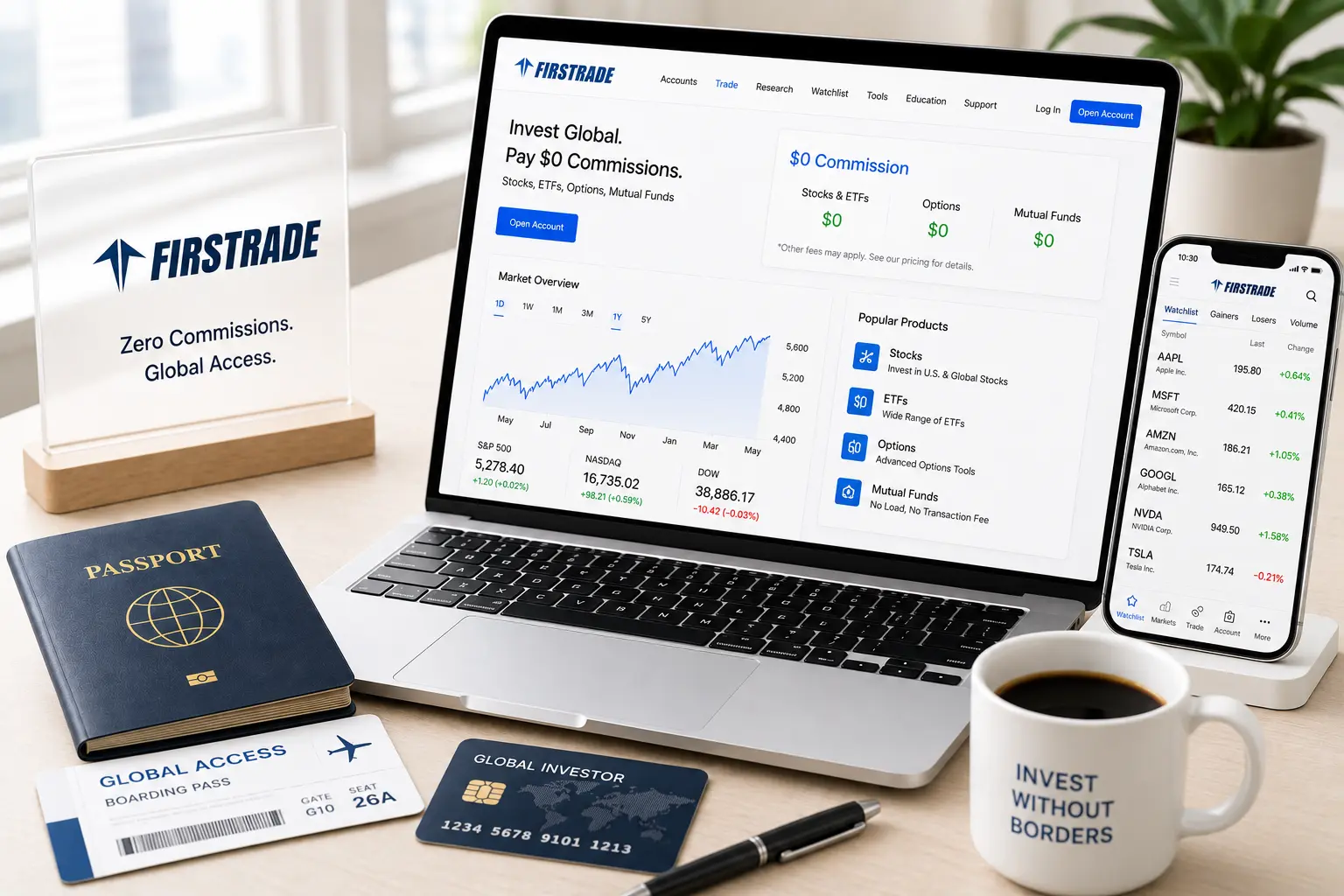
Firstrade isn’t the most sophisticated broker on this list. It won’t win any design awards. But it does two things that matter a lot for international investors: it charges $0 on virtually everything, and it actually accepts clients from 28 countries outside the US when most of its peers stopped bothering years ago.
Whether that’s enough depends entirely on what you need. This review gives you the full picture.
Our rating: 4.0 / 5
Quick Facts
| Founded | 1985, Flushing, New York |
| Regulation | SEC, FINRA |
| Investor Protection | SIPC up to $500,000 + supplemental Lloyd’s of London policy |
| Stock/ETF Commission | $0 |
| Options Commission | $0 per trade, $0 per contract |
| Mutual Fund Commission | $0 |
| Minimum Deposit | $0 |
| International Wire Withdrawal | $25 per transaction |
| Account Currency | USD only |
| Countries Accepted | US + 28 additional countries |
Who Is Firstrade?
Firstrade Securities was founded in 1985 in Flushing, New York - originally built to serve the Chinese-American investment community. Today it operates as a regulated US broker under SEC and FINRA oversight, clearing through Apex Clearing Corporation. It was among the first US brokers to go fully zero-commission, a move that eventually became industry standard.
Revenue comes from margin interest, payment for order flow (PFOF), and spread on fixed income products. That’s standard for zero-commission brokers. Firstrade discloses PFOF practices under SEC Rule 607 and publishes quarterly Rule 606(a) routing reports - transparent and compliant, even if PFOF itself is a topic worth understanding (more on this below).
One detail worth flagging: through Apex Clearing, Firstrade clients benefit from a supplemental insurance policy from Lloyd’s of London syndicates, covering up to $150 million in aggregate once standard SIPC limits are exhausted. It’s an unlikely scenario, but it’s meaningful protection for accounts that grow beyond $500,000.
Availability for International Investors
Most US brokers stopped accepting new international clients years ago - quietly, without announcement, usually buried in a FAQ. Firstrade didn’t. That’s not marketing copy; it’s a genuine operational difference that makes Firstrade relevant to a global audience other platforms have written off.
The International Account is open to non-US citizens without a Social Security Number, provided your country of residence is on Firstrade’s approved list. That list currently includes 28 countries: Germany, the UK, China, Singapore, Hong Kong, Taiwan, and others across Asia and Europe. The full list lives at firstrade.com/accounts/international - check it before you start an application, because it does change.
Account opening is entirely online, takes around 15 minutes, and requires a passport upload for identity verification. Approval typically takes 1-2 business days. No minimum deposit is required. International deposits come via wire transfer and are available for trading as soon as they post, typically within 1-2 business days of sending.
One important restriction: for the first 60 days after a deposit, withdrawals can only be sent back to the originating bank account. Plan accordingly.
Fees
Trading Fees
This is genuinely Firstrade’s strength, and the numbers come directly from their official pricing page:
Stocks and ETFs trade at $0. Options cost $0 per trade and $0 per contract - including exercise and assignment. That last part matters more than most people realize. A broker charging $0.65 per contract on an options trade of 10 contracts costs $6.50. Do that twice a week and you’re paying over $600 a year before any other fee. At Firstrade, that number is zero. For options-active investors, this is a real saving.
Mutual funds trade at $0 across more than 11,000 funds, with one catch: sell within 90 days and you’ll pay a $19.95 short-term redemption fee. Bonds trade on a net yield basis - Firstrade acts as principal with a markup or markdown applied. Primary CDs have a $30 minimum.
Broker-assisted trades cost an extra $19.95 on stocks and ETFs. Use the platform; don’t call.
Non-Trading Fees
There is no account maintenance fee and no inactivity fee. ACH withdrawals are free, but they require a US bank account - which most international clients don’t have.
For everyone else, every withdrawal costs $25 via international wire. Domestic wire is $30. That’s not a penalty fee hiding in the fine print; it’s just the reality of operating a USD-only account from outside the US. If you’re planning to withdraw quarterly, that’s $100 a year in friction before any trading activity. The practical implication: consolidate withdrawals, make them larger and less frequent.
The Currency Issue
Firstrade operates in USD only. No multi-currency account, no FX wallet. Every deposit from a non-USD bank involves a conversion at your bank’s rate, and every withdrawal does the same in reverse. How much this costs depends on your bank and how often you move money - but it’s a real cost that the $0 commission headline doesn’t capture. Investors who fund frequently from a non-USD account should factor this in.
Margin Rates
Directly from Firstrade’s pricing page, with a base rate of 11.00% as of December 2025:
| Balance | Effective Rate |
|---|---|
| $0 - $24,999 | 12.00% |
| $25,000 - $49,999 | 11.75% |
| $50,000 - $99,999 | 11.25% |
| $100,000 - $249,999 | 10.75% |
| $250,000 - $499,999 | 10.50% |
| $500,000 - $999,999 | 8.60% |
| $1,000,000+ | 8.00% |
Interactive Brokers charges around 5-6% on similar balances. On a $50,000 margin position, the difference between 11.25% and 5.5% costs roughly $2,875 per year. Firstrade is simply not the right tool for investors who use leverage.
One more number worth knowing: cash balances earn a flat 0.15% across all tiers. Money market rates in 2026 are meaningfully higher than that. If you’re holding significant uninvested cash, you’re leaving real yield on the table.
Tax Implications for Non-US Investors
This section is the one most international investors don’t read carefully enough - and then regret it.
The W-8BEN Form
Every non-US investor at Firstrade must file a Form W-8BEN. It does two things: it certifies your non-US status, which in most cases exempts you from US capital gains tax on stock sales; and it allows you to claim a reduced dividend withholding rate under your home country’s tax treaty with the US.
The form is valid for three calendar years from the date signed. If it lapses without renewal, Firstrade will withhold 30% on dividends and interest and 24% on sale proceeds. Firstrade sends renewal reminders, but it’s your responsibility to act on them. Missing the renewal is an expensive mistake that’s entirely avoidable.
Treaty rates don’t apply automatically - you have to claim them on the form. The US has treaties with most developed countries that reduce dividend withholding below 30%. How much depends on your country and income type.
Capital Gains
Most non-US investors are exempt from US capital gains tax on stock sales. The W-8BEN is what establishes that status with Firstrade. This is one of the genuine advantages of investing in US markets through a US-regulated broker as a foreign person.
Reporting
Firstrade issues Form 1042-S by March 15 each year, covering US-source income paid to foreign persons and any withholding applied. This feeds into your local tax filing - how exactly depends on your home country’s rules and any applicable tax treaty. A local tax advisor is worth consulting at least once, particularly around the foreign tax credit calculation.
PFOF and What It Means for You
Payment for order flow is how Firstrade - and most zero-commission US brokers - make money on equity and options trades. The broker routes your order to a market maker, the market maker pays for that flow, and the commission you see is $0. The cost isn’t eliminated; it’s embedded in execution quality rather than a visible fee.
This is legal in the US and disclosed. For long-term investors buying liquid ETFs and stocks with limit orders, the practical impact is small. For active traders placing large market orders in less liquid names, it’s worth being aware of.
One note for European investors specifically: the EU banned PFOF under MiFIR Article 39a, with the transition period ending June 30, 2026. This doesn’t affect Firstrade directly - it’s a US broker operating under US rules - but it’s context worth having if you’re comparing Firstrade against European alternatives.
Platform and Tools
Firstrade offers more than its fee structure suggests you’d get, though it’s not built for traders who need professional-grade tools.
WebTrader, the browser platform, is clean and functional. Price alerts, streaming watchlists, basic charting, and a clear portfolio overview. Nothing surprising, nothing broken.
Firstrade Navigator is the advanced layout - resizable widgets, multiple data panels, and a fuller options chain view with the Greeks displayed clearly. More useful for investors who want more information on one screen without switching tools.
The mobile app is where Firstrade genuinely outperforms expectations. The options workflow in particular - scrolling contract chains, Greeks at a glance, smooth order entry - has drawn consistent praise from actual traders. For a zero-commission broker, the mobile options experience is better than the price point implies.
FirstradeGPT, built on FinChat.io, adds AI-powered analysis via a chat interface - natural language prompts returning technical and fundamental summaries with charts. It’s useful for quick research, not a replacement for real analysis.
Research feeds include Morningstar, Briefing.com, Zacks, Benzinga, and PR Newswire. StockBrokers.com independently rates Firstrade’s research as above average relative to US competitors at this price point.
What isn’t here: futures, forex, fractional shares for international account holders, algorithmic order types, a paper trading environment, or charting depth comparable to IBKR’s Trader Workstation.
Account Types and What You Can Trade
Firstrade’s account range is unusually broad for a discount broker. Beyond the standard individual and joint brokerage accounts, it supports Traditional IRA, Roth IRA, Rollover IRA, SEP IRA, SIMPLE IRA (none with an annual fee), custodial accounts, trust and LLC structures, a Coverdell ESA for education savings, and a Cash Management Account with a Visa debit card for clients who maintain at least $25,000 in equity. The IRA depth is relevant for US citizens living abroad or dual citizens who qualify for US retirement accounts.
On the trading side, Firstrade covers the US market comprehensively: stocks across NYSE, NASDAQ, AMEX, and OTC markets; ETFs; options; 11,000+ mutual funds; fixed income including Treasuries, corporate, municipal and agency bonds, and CDs; a limited cryptocurrency selection through Apex Crypto; and overnight trading on eligible securities.
What it doesn’t cover: non-US listed equities, forex, futures. If your portfolio requires access to European or Asian exchanges, this is a hard wall.
Safety and Regulation
Firstrade has been operating continuously since 1985, regulated by both the SEC and FINRA. Client accounts are protected by SIPC up to $500,000 per account (including up to $250,000 in cash), with the additional Lloyd’s of London supplemental policy through Apex Clearing covering up to $150 million in aggregate beyond that. The broker is privately held, which means no public financial disclosures - a minor transparency gap compared to publicly traded competitors, but not a red flag given the regulatory oversight and 40-year track record.
Customer Service
Customer service is the most documented weakness here, and it affects international clients disproportionately. BrokerChooser, which tests broker support through real accounts, rates Firstrade’s service as poor - slow across phone, chat, and email channels. BBB complaint filings show recurring themes: delayed account verification, withdrawal holds, and support staff who appear unfamiliar with individual account specifics. This isn’t a handful of bad reviews; it’s a consistent pattern across years of testing.
Firstrade supports English, Mandarin, and Cantonese - a meaningful advantage for Chinese-speaking clients. For everyone else, it’s English-only during US Eastern business hours.
The honest framing: if you’re a buy-and-hold investor who logs in occasionally and rarely needs help, the customer service gap is manageable. If you’re ever in a position where your account is frozen, a withdrawal is stuck, or something is time-sensitive, this becomes a serious problem with no clean resolution path.
Firstrade vs Interactive Brokers
For international investors, this is the comparison that matters most.
| Firstrade | Interactive Brokers | |
|---|---|---|
| Stock/ETF Commission | $0 | $0 (Lite) / tiered (Pro) |
| Options Per Contract | $0 | $0.65 (Lite) / from $0.25 (Pro) |
| Margin Rate ($25k balance) | 11.75% | ~5-6% |
| International Markets | US only | 150+ markets, 33 countries |
| Multi-Currency Account | No | Yes |
| Fractional Shares | Not for international accounts | Yes |
| Platform Depth | Moderate | Advanced (TWS) |
| Minimum Deposit | $0 | $0 |
| Supported Countries | 28 | 200+ |
| Cash Sweep Rate | 0.15% | Competitive (varies by currency) |
| Customer Service | Poor | Better, 24/5 |
Firstrade wins on options costs and simplicity. IBKR wins on almost everything else. For most international investors building a diversified, long-term portfolio, IBKR is the stronger default. Firstrade earns its place for investors specifically focused on US markets who trade options actively - the per-contract cost difference is real money over time - and who don’t need leverage.
Who This Is For
Think about an investor like David, based in Singapore, building a passive portfolio of US index ETFs and occasionally trading options on individual US stocks. He doesn’t need access to Asian exchanges through his US broker - he uses a local broker for that. He moves money once or twice a year, so the $25 wire fee is an annoyance rather than a meaningful cost. He doesn’t use margin. He’s not going to call customer service; he set his account up once and mostly leaves it alone.
For David, Firstrade is close to ideal. Zero commissions on every ETF purchase, zero per-contract fees on options, solid research tools, and $500,000 in SIPC protection plus the Lloyd’s supplemental. He’s not paying for features he doesn’t use.
Now think about someone building a more complex portfolio - global equities, active leverage, regular fund movements. For that investor, Firstrade’s constraints become real costs fast. IBKR is almost certainly the better fit.
How to Open an International Account
- Go to firstrade.com/accounts/international and verify your country is on the current approved list before doing anything else
- Start the online application and select International Account
- Fill in the form - takes around 15 minutes
- Upload a valid passport for identity verification
- Complete the W-8BEN during onboarding - claim your applicable tax treaty rate
- Fund via international wire transfer (ACH requires a US bank account)
- Allow 1-3 business days for account approval; wire deposits are available for trading once posted, typically 1-2 business days after sending
- Note: for the first 60 days after a deposit, withdrawals can only be sent to the originating bank account
Final Verdict
Firstrade is a broker that does a narrow set of things very well. Zero-commission trading across stocks, ETFs, options, and mutual funds is the real deal - no hidden per-contract fees, no inactivity charges. It accepts international clients from 28 countries when most US competitors don’t. It has a 40-year track record and meaningful investor protection. And its mobile options workflow is genuinely good.
The limits are just as real. A USD-only account, a $25 fee on every withdrawal, margin rates that make borrowing expensive, cash that earns almost nothing, and customer service that multiple independent reviewers consistently rate as slow. For the right investor - passive, US-focused, low-activity, no leverage - none of those limits bite hard. For anyone else, they compound.
The honest summary: Firstrade is a specialist tool. Used for what it’s good at, it’s excellent value. Used as a general-purpose broker for an international investor with complex needs, it will frustrate you.
Rating: 4.0 / 5
This review is for informational purposes only and does not constitute financial or investment advice. Fee data is sourced directly from Firstrade’s official pricing pages, verified against third-party reviews from StockBrokers.com and BrokerChooser. Rates, supported countries, and account terms are subject to change - verify current conditions at firstrade.com before applying. Tax treatment varies by jurisdiction; consult a qualified local tax advisor for your specific situation.